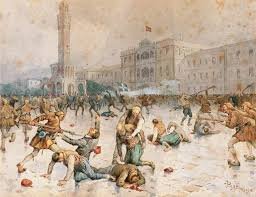
Greek troops landing at İzmir in May 1919. The occupation began with festivities—and was soon drenched in blood.
A Question at the Quay
What does liberation look like? On a bright spring morning in 1919, it looked like cheerful Greek soldiers marching through the streets of İzmir, local Christians applauding them, and Allied warships waiting in the harbor. By noon, however, liberation also looked like Turkish civilians lying on those same streets, their bodies pierced by bayonets and bullets [4]. That was the paradox of the Anatolian campaign: a venture touted as the triumph of a “Greater Greece” turned into a nightmare for the region’s Turks. Between 1919 and 1922, Greek forces advanced through Anatolia under the banner of Allied promises and national grandeur—and left behind massacres, villages in flames, and lives torn apart [2, 3]. This dark page, long ignored or made to be forgotten, raises a troubling question: While trying to “reclaim” ancient lands, did Greece also aim to erase a people? The answer, tucked among testimonies and dusty reports, is as disturbing as it is clear.
Before İzmir: A Decade of Purge
It did not begin in 1919. Violence had been simmering for a decade, part of a spiral of ethnic purges that accompanied the collapse of the Ottoman Empire. During the Balkan Wars of 1912–13, as the Greek kingdom seized Ottoman territories in Europe, countless Muslim Turks were driven from their homes. Entire communities vanished. A Greek report boasted that in newly occupied Macedonia, of 165,000 Muslim and Slavic inhabitants, “only a few families remained” after the army passed [2]. In Western Thrace and Epirus, mosques emptied; Muslim villagers fled or were expelled. Even before the First World War, roughly 80,000 Ottoman Muslims had fled just from Greek-occupied Macedonia [5]. Many of these refugees—along with survivors of earlier bloodshed such as the massacres of Cretan Turks in 1897—found precarious refuge in Anatolia [2]. They were poor and traumatized; they believed the worst was behind them. They did not know that soon a new “liberating” army would again come for them.
The Landing and Early Occupation, 1919
Greek units landed in İzmir on May 15, 1919, with the approval of the Allies, under the pretext of enforcing peace terms on a defeated Ottoman state [4]. Britain’s Prime Minister David Lloyd George, in particular, saw the Greek Army as a handy tool to rein in Turkish nationalism [4]. But from the very first day, reports arrived that the “liberators” were exacting a heavy price from the Muslim population. As Greek forces spread out from İzmir, local Greeks and Armenian armed bands at times joined in attacks on Muslim villages [4, 5]. Untrained volunteers and regular soldiers looted homes; all too often, Turkish peasants were shot or bayoneted at the slightest suspicion. Menemen witnessed one of the first major massacres: in June 1919, amid chaotic fighting with Turkish irregulars, hundreds of Turkish villagers were killed by Greek soldiers [4]. British officers on the scene—such as Admiral Arthur Calthorpe—noted the worrying pattern of reprisals, though their superiors were reluctant to intervene. For the Greek command, these were necessary steps to “pacify” a hostile people. For the Turkish villagers who lived through it, it was an occupying army sworn to cleanse their land.
Aydın: Anatomy of a Massacre
This was seen in its starkest form in the fertile Büyük Menderes valley of western Anatolia. As Greek forces pushed inland through the summer of 1919, securing towns and rail lines, thousands of Turkish farmers fled in fear—often with ample reason. British historian Arnold J. Toynbee, traveling the region, wrote that Greek forces “laid waste the fertile Maeander Valley” and drove out entire Muslim communities [4]. In June 1919, the city of Aydın saw an especially horrifying episode. Greek forces entered Aydın and, after an initial clash with Turkish fighters, took revenge on the civilian population. Nurullah Bey, an Ottoman official of the time, reported that Greek soldiers and collaborating local bands “killed innocent Muslims, including children; openly and secretly raped women; and burned the city with artillery.” As neighborhoods went up in flames, fleeing women and children were cut down by machine guns. Those who could not escape were burned alive in their homes [2, 5]. In a bitter twist, when Turkish irregulars briefly retook Aydın, they did not retaliate against Greek civilians—yet the Greek army, upon reoccupying the ruins, “continued the brutality from where they had left off” [2]. When the smoke cleared, much of Aydın was ash, and thousands of its Muslim residents were dead or displaced. Some may call this “collateral damage”; but as Allied investigators later noted, there was nothing collateral about systematically burning towns and mowing down families as they fled [1].
Strategy Turns to Scorched Earth
Behind this cruelty lay not only battlefield panic but, very often, intent. Determined to suppress Turkish resistance, Greek commanders resorted to classical colonial counterinsurgency tactics—that is, to scorched-earth in the name of “public order” [3]. Villages suspected of harboring bandits were punished collectively. Entire districts were emptied so as not to provide support to guerrillas. Greek officers’ diaries reveal chilling orders. For example, Colonel Stylianos Kondylis—who would later become Prime Minister of Greece—said that during the Aydın campaign they gave their soldiers the “right to do whatever our soul desires” to the locals [2]. A Greek private, Hristos Karagiannis, wrote that this carte blanche opened the door to every kind of abuse and that violence against civilians had “no limit.” Describing the fate of villagers in hiding—“every impossible place is now at the disposal of every Greek soldier”—he noted hearing the unending screams of Turkish women and children [2]. These candid accounts, ignored in Greece for decades, show that the abuse of civilians cannot be reduced to a few “bad apples”; it had turned into a widespread practice, tacitly encouraged by some field commanders. In private letters, a few Allied officers voiced discomfort that their junior partner behaved more like a colonial occupier than a liberating ally [3]. But official geopolitical priorities prevailed: so long as Greece served Allied aims against the Turkish Nationalists, many in London and Paris were willing to look away.
Allies Look the Other Way
International reaction, meanwhile, either remained feeble or carried a cynical air. Winston Churchill—then Britain’s Secretary of State for War—acknowledged the atrocities of Greek soldiers but brushed them off as “small-scale” when compared with the terrible crimes Turks had committed in the past [4]. Apparently, two wrongs could equal a right—or at least a useful excuse. The Great Powers had already branded the Ottoman Turks as cruel actors (not without cause, given the recent Armenian Genocide), and thus the brutality of Christian forces was treated as “understandable revenge.” This moral double standard did not go unnoticed. The fact that the civilizing mission in Anatolia was being carried out with torches and firing squads found its way into diplomatic language with a thin layer of sarcasm. French and Italian observers—less invested than the British in the Greek venture—grew increasingly worried that the occupation provoked exactly what it claimed to prevent: a broader Turkish counteroffensive [4]. By 1921, both France and Italy had made separate peaces with Mustafa Kemal’s Turkish Nationalist government, effectively abandoning Greece’s cause. Britain remained Greece’s main backer, but London’s patience frayed as reports of Greek excesses piled up.
The Yalova–Gemlik Inquiry
The true scale of the excesses came to light in the spring of 1921, when an Inter-Allied Commission of Inquiry visited the Yalova–Gemlik peninsula (just south of İstanbul). Places that had been prosperous farming villages a year earlier had turned into black heaps of ash. From their ship, Commission members saw columns of smoke rising from Turkish villages—as they soon learned, set by roaming Greek and Armenian bands [1]. When they came ashore, they found the bodies of elderly men and women—some sprawled in courtyards, others curled where they had been executed. In the debris of one village, they discovered the miraculously unharmed infant of a Turkish family—the only living being among a pile of corpses [1]. The Commission interviewed Greek officers in the area, and as many Greek, Armenian, and Turkish villagers as they could find. Their conclusions were sharp and clear. In their official report to the British Parliament, they wrote that there was “a systematic plan to destroy Turkish villages and eliminate the Muslim population” in the region [1]. They noted that this plan was being carried out by Greek and Armenian bands under Greek instructions and, at times, with the support of regular units [1]. The implication was plain: elements of the Greek army were not merely failing to restrain reprisals; they were orchestrating them. The Commission observed that whole Turkish communities had “disappeared,” and that the destruction might have aimed to create a new political reality favorable to Greece [1]. In simpler words: ethnic cleansing.
Of course, the report also noted context: in 1920, Turkish forces had burned Greek villages in the region and massacred Greek civilians [1]. What happened in Yalova in 1921 was partly a ghastly cycle of reprisals. But the Commission especially emphasized that nothing could justify the scale and meticulousness of the ongoing purge of Muslims. It described Greek and Armenian bands combing the countryside with the intention of permanently expelling Turks [1]. Toynbee, who accompanied the investigators for part of the mission, called the condition of Turks in Greek-occupied areas “a reign of terror” [4]. The evidence he and others collected showed that what they witnessed in Yalova—burned homes, lynched villagers, survivors trembling in fear—was occurring on a broad scale wherever Greek units met resistance [1, 4]. The Yalova inquiry offered a rare moment of international clarity about the character of the Greek occupation. For a moment, the Great Powers could no longer pretend that everything was fine behind the Greek lines.
War Rhetoric at Home
In Athens, however, these accusations were batted away or lost amid the blaze of war. Greek newspapers of the time framed the conflict in starkly racist tones. One paper openly declared that “this war is between the Greek race and the Turkish nation; it will continue until one side is exterminated” [2]. That chilling sentence—which effectively urges the annihilation of one side—summed up the mood of extreme nationalists who saw Anatolia not as a multicultural homeland to share, but as a Greek inheritance to be won “at any cost.” With such rhetoric in circulation, it is hardly surprising that soldiers and paramilitaries felt authorized to commit the unspeakable. Some rank-and-file did so with zeal; others, doubtless, with disgust and fear. The renowned Greek writer Stratis Myrivilis confessed that as a young soldier in 1912 he had been ordered to shoot an unarmed old Turk, and that the look on the man’s face as he died haunted him for life [2]. If such pangs of conscience also existed during the Anatolian campaign, they were not much voiced at the time. A few dissenters in Greece (including socialists and some opposition politicians) protested the cruelty, arguing that a nation cannot build its freedom on the oppression of another. But these voices were drowned out by propaganda promising a swift victory and the brute reality of young men swept to the front. For most people in Greece, news from Anatolia was filtered and polished—tales of heroism, not of massacres. The smoking villages of distant Anatolia remained out of sight and thus out of mind.
The Burning Retreat of 1922
Meanwhile, the spiral of violence tightened. By 1922, the Greek army had overextended deep into Anatolia, and morale had collapsed. Under Mustafa Kemal Atatürk, Turkish Nationalist forces launched the decisive Great Offensive in August 1922. As the Greek front shattered, a chaotic retreat began toward the Aegean coast. In the final weeks, disaster came from both sides. Hoping to leave only scorched earth to the enemy, Greek units set towns ablaze as they fell back. Witnesses reported the city of Manisa torched by retreating Greek forces, its ancient bazaars and neighborhoods turned to ash [4, 5]. Turkish officials counted more than 17,000 homes destroyed in Manisa alone and alleged that hundreds of civilians who could not evacuate were slaughtered. Similar fires were recorded in Alaşehir, Turgutlu, and dozens of other towns—a deliberate burn pattern that led one Allied officer to liken the Greek retreat to “a trail of flames” [4, 5]. A despairing Greek diarist wrote in early September that every village they passed “was burning, columns of black smoke rising on the horizon,” and grimly noted that “the entire country seems torch-lit by our departure.” The aim was partly tactical—denying the advancing Turks shelter and supplies—but also carried a vindictive logic: if these lands could not be Greek, then let them burn. Amid the chaos, Turkish peasants—especially the elderly and infirm who could not flee—were wiped out. Some Greek officers tried to prevent abuses during the retreat, but discipline had unraveled. In a horrifying account, a Turkish lieutenant arriving in a recaptured village found nine dismembered villagers laid out in a grotesque display—an atrocity so extreme that it drove him and his men to kill Greek POWs in revenge [4]. The fire of war’s barbarity had reached its zenith.
İzmir’s Catastrophe and the Population Exchange
In mid-September 1922, victorious Turkish Nationalist armies entered İzmir; the war effectively ended. What followed is broadly known: much of İzmir’s Christian quarter went up in flames, and the city’s Greek and Armenian population suffered terrible massacres and expulsions under Turkish retribution [4]. The İzmir Catastrophe, as Greeks call it, may have claimed 50,000–100,000 Christian lives; people crowded the shore, clinging to foreign ships in search of rescue [4]. That apocalyptic finale—this time with Greeks and Armenians as victims—often eclipses the equally tragic phases that preceded it. Yet it had been Turkish civilians in the Anatolian interior who suffered four long years of terror under occupation, only to see similar torments visited upon their tormentors at the end. The war’s outcome led to an almost total population swap: in 1923, Greece and the young Republic of Turkey agreed to a compulsory exchange. More than a million Anatolian Greeks were sent to Greece, and roughly half a million Turks in Greece to Turkey. It was a bleak diplomatic solution that officially ratified what war and atrocity had already achieved on the ground—the ethnic “unmixing” of Anatolia. Notably, as part of the peace, both governments tacitly ignored each other’s wartime crimes through amnesties. The 1923 Treaty of Lausanne formally relieved the parties of prosecuting war crimes [3]. In other words, the sins of the Greek army (and of the Turkish army) were brushed under the official rug for the sake of stability and reconstruction.
Memory, Silence, and Academia
And so, for decades, these events lived mostly in the traumatized memories of survivors and in buried archives. In Greece, public discourse focused on the nation’s own suffering in 1922—“Η Καταστροφή” (“The Catastrophe”)—while a curtain was drawn over what Greek forces had done in Anatolia before the collapse [3]. This was not exactly a state secret but a national silence. Textbooks and speeches commemorated the heroism of the Asia Minor campaign, yet rarely mentioned its cruelty. To admit the cruelty was to arm old enemies or stain the honor of those who fought. Only in recent years have Greek historians like Tasos Kostopoulos begun to draw back the curtain. Using soldiers’ diaries and military archives, Kostopoulos confirms that what happened between 1919 and 1922 was not a “series of unfortunate excesses,” but a continuous pattern of ethnic violence [2]. Whole populations were deliberately uprooted in the service of nationalist aims. As Kostopoulos bluntly puts it, the “glorious decade” of 1912–1922 had a “dark face” of burned homes and broken lives that official history ignored [2]. This acknowledgement is gradually seeping into Greek public debate, though hardly without controversy. Challenging a national narrative takes courage; those who do—like Kostopoulos—have faced backlash for speaking about the war’s “forgotten side” [2].
What Remains
So what is the legacy of those bloody years? For Turkey, the Greek invasion and its cruel execution became woven into the founding story of national rebirth. Turkish villagers’ suffering at the hands of the Greek army is remembered as part of the “War of Independence”—a cautionary tale of how close the nation came to partition and how it survived. In Greece, the legacy is more fragmented: the dominant memory is tragic loss—burned İzmir and desperate refugees—while the voices about what Greek forces did before defeat remain hushed. Yet history, like the Aegean waves, eventually washes truth ashore. A century on, researchers and descendants on both sides comb archives and testimonies to build a more complete narrative. It is not a fable of one side angelic and the other demonic; it is the story of a brutal war in which civilians were systematically targeted. Greek units, driven by a toxic mix of revenge, fear, and expansionist ideology, committed systematic abuses against Turkish Muslims [1, 2]. These acts meet the definitions of ethnic cleansing and have led some to argue that, in intent—if not in scale fully realized—they constituted genocide. The Greek state may not have completely annihilated the Turks of Anatolia—military defeat prevented it—but the intent observable in the field was to “extinguish” a people from their land, as Allied investigators recorded with horror in 1921 [1].
By 1922, Greeks and Turks had exchanged places in tragedy. Anatolian villages that had stood for centuries were emptied of their Turkish inhabitants—some fled reprisals, others lay in mass graves or at the bottoms of wells. In Greece, once-prosperous communities of Anatolian Greeks were likewise destroyed or expelled. The Greek military adventure that began with bands and flags in İzmir’s harbor ended as a battered heap of ambitions. But among the ruins it left uncountable ghosts: the Turkish farmer shot while defending his home; the imam and congregation locked in a mosque and burned; the mother and child riddled with bullets as they ran from the flames. These are the ghosts of a “forgotten genocide,” the victims who find little space in history books—especially those outside Turkey. Perhaps the bitterest irony is that both Greece and Turkey emerged from that decade as more homogeneous nation-states, with a hardened resolve to remember only their own martyrs. There are few memorials to the Turks of Anatolia who died at the hands of the Greek army. Yet stories once whispered are now spoken more openly; historians from all sides strive for honesty.
A scene from 1919 lingers: a Greek officer on a village street, smoke rising from burning houses, reporting to his superiors that “the area has been cleansed.” That bare image captures the essence of what happened. The language of cleansing or purification—ethnic cleansing—guided far too many actions in those years [2]. A war of flags and front lines became a war on families and communities. And even if the map could not be redrawn as Venizelos or Lloyd George envisioned, it succeeded in erasing multitudes. This is the face of the Greco-Turkish War worth remembering—not to stoke spite, but to honor truth. To remember that no nation’s cause—however just it may appear—is immune to unjust deeds. To recognize that the victims of 1919–1922 were not only those visibly defeated in 1922, but also those quietly extinguished before. The words attributed to an elderly Ottoman Muslim, driven from his burning home by Greek soldiers, whether true or not, make for a somber close: “They call this liberation—but the only thing they liberated us from was our lives.” In the pursuit of national glory, the real war often isn’t on the front lines at all; it unfolds in villages and out-of-the-way places—where ordinary people either survive the storm of history, or become its victims.
References
[1] Inter-Allied Commission of Enquiry. (1921). Reports on atrocities in the districts of Yalova and Gemlik and in the Ismid Peninsula. London: HMSO.
[2] Kostopoulos, T. (2007). Πόλεμος και εθνοκάθαρση: Η ξεχασμένη πλευρά μιας δεκαετούς εθνικής εξόρμησης, 1912–1922 [War and Ethnic Cleansing: The Forgotten Side of a Decade-Long National Campaign, 1912–1922]. Athens: Vivliorama.
[3] Kostopoulos, T. (2023). The other side of the Catastrophe. In P. Carabott & W. W. Ledeboer (Eds.), Encounters with troubled pasts in contemporary Dutch and Greek historiography (pp. 223–246). Leiden: Sidestone Press.
[4] Toynbee, A. J. (1922). The Western question in Greece and Turkey: A study in the contact of civilizations. London: Constable.
[5] Gingeras, R. (2009). Sorrowful shores: Violence, ethnicity, and the end of the Ottoman Empire, 1912–1923. New York, NY: Oxford University Press.