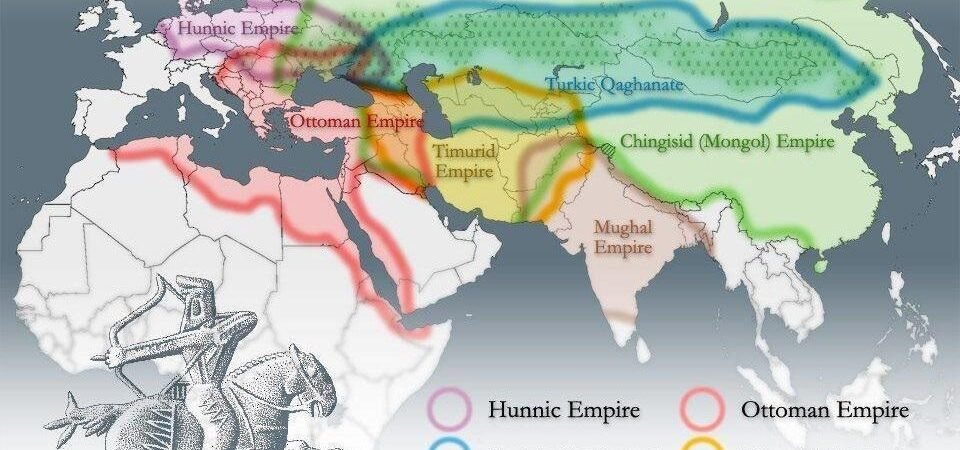
In the spring of 452, a tense hush falls over a Roman city as dust clouds on the horizon signal the approach of horsemen. Attila the Hun—“Scourge of God” to the frightened Europeans chronicling his advance—is at the gates. Fast forward exactly one millennium: in 1453, Sultan Mehmed II stands before the massive walls of Constantinople, Ottoman cannons thundering. One was a nomadic warlord on horseback; the other, a monarch in a palace—yet both were Turks, heirs to a sweeping saga that spans continents and centuries.
What do a fur-clad steppe nomad and a silk-robed sultan have in common? Quite a lot, it turns out. Both represent chapters in the epic story of the Turkic peoples, a story that began in the windswept grasslands of Central Asia and eventually stretched from the Great Wall of China to the gates of Vienna. Over about two thousand years, Turkic-speaking peoples went from tribal nomads to empire builders, sprinkling the Old World with a dash of steppe swagger. In the process, they founded empires, tangled with some of history’s greatest figures, and occasionally acquired dramatic nicknames (Attila didn’t choose “Scourge of God,” but it certainly helped his PR). Through subtle twists of fate and tenacious adaptability, the Turks left an indelible mark on world history—often with a sly sense of irony that might elicit a wry smile over coffee.
Before we delve into this journey, let’s set the scene. Imagine the Eurasian Steppe around two thousand years ago: an ocean of grass where skilled horsemen gallop beneath endless skies. These early nomads lived by their wits and their herds, shifting with the seasons in search of pasture. They had no sprawling cities or written records, so outsiders spun myths about them. The Chinese built a Great Wall to keep the northern tribes at bay and described them as fierce, fast riders who could “shoot arrows while hanging from the saddle”—essentially the special forces of the ancient world. It’s among these roaming clans that the Proto-Turkic people slowly formed a distinct identity. No one penciled in an exact date or place for the “birth” of the Turks (record-keeping wasn’t a nomadic strength), but linguists and archaeologists suggest the early Turkic tongue arose somewhere in the heart of Inner Asia, amid forests and grasslands that nurtured a hardy equestrian culture.
Even the etymology of “Turk” hints at their self-image. In Old Turkic, türk reportedly meant “strong” or “vigorous,” implying a people in their prime. According to legend, one early Turkic hero was raised by a she-wolf named Asena, whose iron will (and perhaps iron teeth) imbued his descendants with boldness. This wolf tale might be a metaphor—after all, surviving the unforgiving steppe required a bit of wolf-like ferocity. The first time “Turk” appears in the political record is in the 6th century, when a powerful nomadic empire proudly adopted that name. But long before that, the ancestors of the Turks were already making strategic cameo appearances in the chronicles of bigger civilizations.
By the 3rd century BCE, Chinese historians were noting troublesome nomads on their frontiers, such as the Xiongnu. Some scholars later speculated that the Xiongnu could have been early Turkic speakers (a controversial idea, but one with tantalizing hints). Fast-forward to late antiquity: waves of nomadic invaders battered at the Roman world’s borders during the Great Migration Period. Among them were the Huns, a confederation of steppe warriors whose exact ethnic makeup remains mysterious. Many historians today believe the Huns were a mix of peoples—including possibly Turkic tribes descended from the Xiongnu. They burst into Europe from the east, “swarming” (as panicked chroniclers put it) across the plains. Around 370 CE, these Huns conquered and scattered Germanic tribes, setting off domino-effect migrations toward Roman lands. In the 440s, Attila unified the Hunnic bands and led them on a whirlwind of conquest that made him the bogeyman of the late Roman Empire.
Attila’s Huns were nomadic horse archers par excellence, living off the land and tribute, striking terror into settled folk who had never seen such mobility in warfare. To Roman writers, they seemed like men “born in the saddle,” appearing out of nowhere, plundering, then vanishing with equal speed. Attila himself earned an infamous reputation. Western observers—perhaps prone to melodrama—branded him the “Scourge of God,” blaming him for divine punishment upon Rome’s sins. The nickname stuck, and one imagines Attila hearing of it and chuckling darkly into his mead. Yet for all his ferocity, Attila showed flashes of pragmatism. In 452, he marched into Italy, sacking cities, but he never actually took Rome itself. According to later legend, Pope Leo I rode out to meet Attila and implored him to turn back; whether spooked by a supposed heavenly vision or simply sensing logistical issues (those Italian summers can be murder on an army’s supply lines), Attila withdrew. The “Scourge of God” died shortly after—in a twist worthy of a soap opera, supposedly from a nosebleed on his wedding night—and his empire collapsed by 469 CE. Not a bad run for a group that likely emerged from the Central Asian steppe.
So were the Huns Turks? In a cultural sense, they were precursors. They spoke a language that might have been Turkic (though we lack a Hunnic phrasebook to know for sure) and many of Attila’s known relatives had Turkic names. We do know that the Huns’ sudden appearance was part of a wider westward drift of Turkic nomads. They paved the way for other Turkic tribes to move into Europe’s fringes. Attila’s shockwaves helped topple the Western Roman Empire, but that was just the overture. In the centuries after the Huns, new Turkic peoples would ride out of Asia, armed with bows, boldness, and an uncanny talent for seizing opportunity. The stage was set for the Turks to step fully into the historical spotlight, and when they did, they would make even bigger waves—founding states, embracing world religions, and blending their steppe heritage with the civilizations they encountered.
With that vivid prologue in mind, let’s journey through the major acts of Turkic history. We’ll meet wolf-inspired rebels forging empires, slave-soldiers toppling their masters, and sultans drinking coffee in gilded palaces—all tied together by the resilient thread of Turkic language and culture. It’s a tale of adaptation and adventure, told with the authority of historical research and a wink of humor. After all, history is best appreciated not just with facts and dates, but with an understanding of the people’s spirit—their grit, wit, and occasional audacity. And the Turks, as we’ll see, have never lacked for any of that.
Nomads of the Steppe – Origins of the Turkic Peoples (Pre-6th Century)
Long before the Turks built cities or thrones, they were wanderers in Central Asia. Picture the Altai Mountains and the great steppe around them—this is the ancestral homeland often pointed to as the crucible of the Turkic peoples. Here, for millennia, tribes roamed with their flocks of sheep and horses, developing a life in harmony with the rhythms of nature. They dwelt in felt-covered yurts that could be packed up and moved at a moment’s notice. Their world was one of open horizons, where survival meant riding hard, shooting straight, and knowing your neighbors (and when to raid them).
In these formative centuries, the term “Turk” didn’t refer to a nation-state or a single ethnicity as we think of it today. Rather, it was an evolving identity among kindred tribes. They shared languages from the Turkic family—an Altaic tongue of agglutinative words and vowel harmony (linguistic quirks that make Turkic languages sound melodious and a bit like a verbal jigsaw puzzle). The Chinese, great record-keepers of antiquity, noted various nomadic groups in the eastern steppe. They called one powerful early group the Xiongnu. Around the 3rd century BCE, the Xiongnu formed a formidable confederation north of China. These adversaries were possibly multi-ethnic, but intriguing clues link them to the later Turks. Chinese chroniclers mention tribes like the Dingling (丁零) and others under Xiongnu rule, and some researchers propose that the Dingling were early proto-Turkic people.
To the west, other Iranic and Ugrian nomads mingled with emerging Turkic clans. The steppe was a giant mixing bowl, and out of it arose groups whose names flicker through ancient sources: Wusun, Yuezhi, Hunas (possibly related to Huns), and more. It’s a challenge to untangle, like trying to identify individual spices in an ancient stew. What we can say is that by the early centuries CE, tribes speaking Turkic dialects were widespread across Central Asia’s plains and valleys. They worshipped sky gods like Tengri, practiced shamanism, and measured wealth in livestock and the valor of their warriors.
An important concept in their culture was the “khan”, or chieftain. Leadership in the steppe was often fluid—charismatic leaders could attract followers and forge a union of tribes, but if fortune turned or a khan showed weakness, his confederation could evaporate like morning dew. This dynamic meant that steppe politics were an ever-shifting tapestry of alliances and betrayals. (One might say backstabbing was as common as horseback riding out there, sometimes both at once.) Strong clans like the Ashina began to stand out. According to legend, the Ashina were a noble Turkic family who themselves descended from that mythical wolf Asena—giving them a divine pedigree to go with their political ambitions.
By the 4th and 5th centuries CE, as the Western world dealt with the fall of Rome, the Inner Asian steppes were incubating the next big Turkic breakout. We already met the Huns rampaging through Europe in Attila’s time. In their wake, other groups pushed westwards: the Bulgars, for instance, who were Turkic-speakers moving into Eastern Europe around the Black Sea. One branch of Bulgars would eventually establish a state in the Balkans (giving Bulgaria its name), though they later Slavicized and their Turkic tongue faded. Another branch, the Volga Bulgars, settled along the Volga River; interestingly, they embraced Islam around the 10th century and are ancestors of some of today’s Tatars. We see here a recurring pattern: Turkic folks often migrated in waves, some continuing on, others planting roots and blending with locals, adopting new religions and identities. Yet even as they changed, they carried elements of their Turkic heritage with them—language, legends, and that roaming spark.
During these early centuries, the Turks were usually the outsiders looking in on the old civilizations—trading, raiding, or serving as mercenaries. In the Middle East, the Byzantine and Sassanian Persian Empires occasionally enlisted steppe warriors to fight their wars (finding out too late that hiring nomads is like grabbing a tiger by the tail). In China, emperors dealt with the northern nomads through a mix of diplomacy, intermarriage (sending “princesses” to marry khans), and military campaigns. Despite walls and treaties, the frontier was porous. Turkic tribes like the Tiele (also called Gaoche) and others appeared in Chinese records, sometimes as allies, other times as rebels.
By the 6th century, it was clear a new power was coalescing in the heart of Asia. Turkic tribes were uniting on an unprecedented scale, poised to challenge the old order. The spark came from an unexpected quarter: a humble blacksmith’s clan (if legend is to be believed) that would hammer out the first Turkic empire. The Ashina clan, possibly refugees-turned-forge-masters for a rival tribe, seized their moment. In the year 552 CE, under the leadership of Bumin Qaghan, the banner of the Göktürks was raised, and suddenly the Turks were no longer just peripheral nomads—they were empire-builders in their own right.
Forging the First Turkic Empires (6th–8th Centuries)
The word “Göktürk” means “Celestial Turk” or “Blue Turk” (blue evoking the eternal sky in Turkic symbolism). These Göktürks weren’t calling themselves blue out of the blue—their steppe Tengri religion revered the blue sky, and they likely saw their empire as mandated by heaven. With stunning swiftness, Bumin Qaghan and his successors carved out a vast dominion. They overthrew their overlords, the Rouran Khaganate (a predecessor Mongolic empire that had kept the Ashina as vassals), and established the First Turkic Khaganate. Contemporary Chinese sources referred to the Göktürks as Tūjué (突厥), recognizing them as a new and formidable entity. By the mid-6th century, the Göktürk Empire stretched from the plains of Mongolia and the fringes of China all the way west to the Black Sea. This was a staggering leap onto the world stage—the Turkic people had arrived as a political force, announcing themselves with the ring of iron horse-hooves across Eurasia.
How did a coalition of nomads conquer such a huge realm so fast? Part of the secret was savvy alliance-building and military might. The Göktürks knew how to fight (a lifetime of hunting and raiding will do that), and they knew how to win friends. They swiftly struck a partnership with the Byzantine Empire to their west, united by a common enemy: the mighty Sasanian Persian Empire. One Göktürk leader, Istämi, sent an embassy to Constantinople in the 560s—a startling sight for Roman nobles to see turbaned Turkic ambassadors at court. The Byzantines and Göktürks coordinated attacks on Persia from two sides. It was a classic “enemy of my enemy” scenario, and it worked: the Persians were pressured, and the Silk Road opened for direct trade between Byzantium and the Far East (bypassing Persian middlemen). The Göktürks grew rich on this commerce, controlling the caravan routes that connected China to Europe. One Chinese envoy in 568 marveled at the Göktürk capital—likely in what’s now northwest Mongolia—where he saw silks from China, gold from Byzantium, and exotic wares from India. The nomads had become cosmopolitans of the steppe, without losing their rough edges.
The Göktürk Khaganate at its height was impressive but also inherently unstable—much like a patchwork quilt of tribes stretched taut. By 581, internal rivalries and the sheer size of the realm led to a split into Eastern and Western Turkic Khaganates. Each had its own khagan (khan of khans) and dealt with different challenges. The Eastern Göktürks, based in Mongolia, engaged in a complex dance with China’s Tang Dynasty—alternately raiding and submitting as vassals, depending on which side had the upper hand. The Western Göktürks dominated Central Asia, from the Altai mountains through Transoxiana (modern Uzbekistan/Kazakhstan) toward the Caspian. They interacted with the Byzantine Empire, Persia, and various proto-Slavic and Finno-Ugric peoples in the west.
Notably, the Western Turkic realm included the Onogurs and Bulgars around the Black Sea, hinting at the future Bulgarian kingdom. It also bumped up against the Avars in Europe—another steppe group that some say was an offshoot of the Göktürks (the Göktürks themselves referred to the Avars as a kind of “fake” khanate, using a pejorative name). Clearly, Turkic influence was radiating in all directions.
During this time, the first known Turkic writing system emerged: the Old Turkic runes, also called the Orkhon script. Sometime in the 7th century, Göktürk scribes began inscribing their history and wisdom on stone steles. This was a monumental cultural moment—these nomads left their own written record. The most famous are the Orkhon Inscriptions in Mongolia, erected by a later Göktürk generation in the early 8th century. In beautifully poetic Old Turkic, they tell of the legendary Bilge Khagan and his brother Kül Tegin, praising their deeds and, interestingly, chiding the Turkic people for forgetting their heritage and falling under Chinese sway before a heroic revival. In one passage, Bilge Khagan (or rather, his memorial voice) advises, “O Turk, if you abandon your state and traditions and become Chinese-like, you will perish” (a rough paraphrase). The inscriptions are both propaganda and heartfelt elegy—imagine a wise elder’s voice echoing across the windswept plains, urging future generations to stay strong and united. It’s poignant that these words, carved in stone around 732 CE, were meant to prevent the very cycle of rise and fall that the Göktürks themselves were undergoing.
Indeed, the Göktürk Empire did fall—more than once. The Eastern Khaganate was conquered by Tang China in 630 CE, humiliatingly ending the first Turkic empire. But Turkic resilience shone through: by 682, the Turks had rebelled against Chinese rule and restored a Second Turkic Khaganate under the leadership of Ilterish Qaghan and later Bilge Khagan (the one from the inscriptions). This renaissance didn’t last forever, but it cemented certain legacies: the idea of a Turkic state, the use of a Turkic written language, and the notion of the Turks as a distinct political-military force in the world. The Second Khaganate eventually fell in 744, brought down by internal strife and a revolt by allied tribes (particularly the Uyghurs). But by then, the genie was out of the bottle—other Turkic powers were rising in the former Göktürk territories.
One such successor was the Uyghur Khaganate (744–840), a Turkic empire that ruled Mongolia and parts of Xinjiang. The Uyghurs were fascinating: they were Turks who adopted a cosmopolitan life, building cities like Ordu-Baliq and embracing religions like Manichaeism (a gnostic faith from Persia). Their realm became a haven of trade and culture; Uyghur Turks wore silk robes, read translated scriptures, and corresponded with Tang Chinese as equals. Meanwhile, further west, the Khazar Khaganate emerged in the 7th century north of the Caucasus. The Khazars, another Turkic people, are famous for something unusual: their ruling elite converted to Judaism around the 8th or 9th century. Surrounded by Christian Byzantines and Muslim Arabs, the Khazar royalty seemingly picked a third option, perhaps to remain neutral in a religiously charged region. The cosmopolitan Khazar capital, Itil, hosted mosques, churches, and synagogues—an island of relative tolerance. (One can imagine a Khazar merchant cheerfully greeting a visitor with “Shalom, salaam, and peace be with you,” covering all bases.) The Khazars acted as a buffer state, holding back the expansion of the Islamic Caliphate into the Caucasus for a time, and they grew wealthy from trade across the Volga.
By the 8th century, Turkic peoples had firmly implanted themselves across Eurasia. They were no longer just steppe raiders haunting the edge of civilization—they were civilization in many regions, or an integral part of it. From the bustling markets of the Khazar domains to the sacred stele fields of the Orkhon, Turks had proven adept at both war and statecraft. Yet their greatest transformations were still to come. In the next act, we’ll see the Turks encounter two forces that would profoundly reshape their destiny: Islam and the legacy of the Mongol conquests. But first, a pivotal chapter unfolded as the Turks rode into the Muslim world, forever altering the trajectory of the Middle East.
Turks Embrace New Faiths: Islam and the Turkic Migrations (8th–10th Centuries)
As the first millennium CE drew to a close, the Turkic nomads found themselves increasingly entangled with the dynamic new civilization of Islam. The rise of Islam in the 7th century had united the Arabian Peninsula and exploded outwards in a series of astonishing conquests. By 751, Arab-Muslim armies had reached the far east of Central Asia, where they clashed with Tang Chinese forces in the famous Battle of Talas. At Talas, local Turkic tribes (notably the Karluks) played kingmaker by switching sides to help the Arabs defeat the Chinese. This little-known battle had big consequences: it checked Chinese expansion into Central Asia and opened the door for Islam to gradually become the dominant faith there. Chinese prisoners captured in the battle reputedly taught the Arabs the secret of papermaking, but more lastingly, Talas signaled that the cultural tide in Central Asia was turning toward the Middle East and Islam.
In the aftermath, Turkic tribes in Transoxiana (the land between the Amu Darya and Syr Darya rivers) began interacting more with the Muslim Caliphate. Some Turks served as mercenaries in Muslim armies, while others traded with Muslim merchants. Over generations, many Turkic communities slowly adopted Islam, not usually by the sword but through contact, intermarriage, and the influence of missionaries and Sufi mystics who found the Turkic steppe a fertile ground for spirituality. By the 10th century, a critical mass had been reached: the Karakhanid Khanate, a confederation of Karluk Turkic tribes, embraced Islam and became the first fully Muslim Turkic state. Tradition credits Sultan Satuq Bughra Khan (d. 955) as the Karakhanid ruler who converted and then promoted Islam among his people. The Karakhanids took control of cities like Kashgar and Balasagun, establishing mosques and madrassas. Imagine a Turkic chieftain swapping his shaman’s fur cap for a turban and learning to recite the Quran—gradually, the rhythm of Turkic life was infusing with Islamic piety.
This was a profound transformation. The Turks had traditionally been Tengri-worshippers (sky-god devotees) with shamans mediating between the human and spirit worlds. Conversion to Islam introduced them to a sophisticated written scripture, new laws, and a connection to the broader Muslim world spanning from Spain to India. Yet, characteristically, the Turks adopted Islam on their own terms. Many held onto elements of their prior culture. For instance, reverence for the sky and nature didn’t vanish overnight; it morphed into poetic Sufi Islam that saw God’s grandeur in the vast steppe and endless sky. The Turkic language gained a raft of Arabic and Persian loanwords as they discussed theology and philosophy, but it remained the tongue of everyday life and epic poetry.
One colorful example of cultural blending is the legacy of Mahmud al-Kashgari, an 11th-century Karakhanid scholar. He wrote a remarkable work, the Diwan Lughat al-Turk, basically an Arabic compilation and explanation of Turkic languages, complete with poetry and proverbs. Mahmud’s tone in that book is subtly proud—he was essentially telling the Arab-Muslim world: “You’d better study Turkic, because we Turks are important now.” And he was right. By the year 1000, Turkic warriors had become the steel core of many Muslim armies. The Abbasid Caliphs in Baghdad, starting from the 9th century, had begun purchasing Turkic slave-soldiers (ghulams or mamluks) for their military—valuing their toughness and outsider loyalty. Paradoxically, these enslaved fighters often ended up the real powers behind the throne. They were like the indispensable bodyguards who eventually bossed around the king. In Baghdad, the Turkish guard grew so influential (and occasionally unruly) that caliphs sometimes felt like hostages in their own court.
Meanwhile, on the frontiers, Turkic chieftains were carving their own realms. The Oghuz Turks (a western Turkic branch) had been pushing from the Jaxartes toward Iran. One Oghuz tribe, led by a chief named Seljuk, converted to Islam in the 10th century and entered Persian service. Little did anyone know that Seljuk’s line would birth an empire that would shake the Middle East. Around the year 1037, Seljuk’s grandsons—Tughril and Chaghri Beg—rallied the Oghuz warriors and exploded into Khorasan (northeastern Iran), defeating the local rulers. In 1040, at the Battle of Dandanaqan, they crushed the Persianized Ghaznavid Empire’s army. By 1055, Tughril Beg entered Baghdad as a savior, at least in the eyes of the Abbasid Caliph who was then beleaguered by Shi’a Buyid warlords. Tughril kicked out the Buyids and received the Caliph’s recognition as Sultan, effectively becoming the secular arm of the Sunni Muslim world. Thus was born the Great Seljuk Empire, a Turkic-Muslim powerhouse that would dominate West and Central Asia for the next century and more.
It’s hard to overstate how momentous this was: a Turkic dynasty now sat atop the Islamic Middle East, ruling over Persians, Arabs, Kurds, and others. The Seljuks, once tent-dwelling nomads, inherited the rich urban cultures of Persia and the Arab world. To govern these lands, they adopted Persian as the language of administration and high culture, thus becoming a Turko-Persian empire. This led to a brilliant fusion: Turkic ruling vigor combined with Persian bureaucratic finesse and Islamic civilization’s knowledge. The Seljuk sultans like Alp Arslan and Malik-Shah surrounded themselves with learned viziers such as the famous Nizam al-Mulk, who systematized governance and founded universities (the Nizamiyyah madrasas). Under their reign, science, art, and architecture flourished—from the creation of observatories to the building of the sublime Isfahan mosque. Yet the Seljuks never forgot their steppe roots entirely: they still loved hunting and deployed swift cavalry in battle. A bit of the old nomad ethos remained under the Persian robes.
The Seljuks also ushered in new geo-political realities. In 1071, Sultan Alp Arslan met the Byzantine Emperor Romanus IV at the Battle of Manzikert near Lake Van. In a shocking upset, the Seljuk army routed the Byzantines; Emperor Romanus IV was captured. Alp Arslan treated the defeated emperor with unexpected magnanimity—legend says he asked Romanus what he’d do if their roles were reversed; the emperor replied he’d likely kill Alp Arslan, to which the Sultan quipped that his punishment would be far worse: he was going to forgive him. True or not, after a friendly ransom and exchange, Romanus was released (only to be overthrown and blinded by his own people later—talk about adding insult to injury). Manzikert was more than a battle; it was the gateway for the Turks into Anatolia (Asia Minor). In its wake, Turkic Oghuz tribes (the Turkmens) flooded into the Anatolian plateau, finding a land of rolling pastures uncannily like their steppe homeland. Within a decade, they had seized most of Anatolia from Byzantine control. The foundations of what would later become Turkey were thus laid in the 11th century, thanks to Manzikert. If one were to pick a single year when “the Turks arrived” in the Middle East in force, 1071 would be a prime candidate. Byzantines, stunned by the disaster, soon called for help from Western Europe, inadvertently starting the Crusades—but that’s another story.
Meanwhile, other Turkic-led states popped up like mushrooms after rain. In Iran and Central Asia, smaller sultanates spun off as the Great Seljuk Empire fragmented in the 12th century (family quarrels were a Seljuk specialty). The Khwarezmian Empire rose in their stead in the late 1100s, led by former Seljuk vassals of Turkic origin who decided to go independent. In India, Turkic adventurers made their mark too. As early as the 10th century, Turkic slave-soldiers under the Persian Samanid dynasty broke off to form the Ghaznavid Empire (named after Ghazni in today’s Afghanistan). Sultan Mahmud of Ghazni (r. 997–1030) was a brilliant if brutal conqueror who carried out raids deep into India, seeking loot and spreading Islam—though one suspects the loot often took priority. He brought back immense wealth (and a cohort of Indian artisans and scholars) to adorn his capital. Though Persian culture strongly influenced Ghazni’s court, the ruling elite were Turkic, and they never lost their appetite for conquest. Later, in 1206, a Turkic general in India named Qutb al-Din Aibak declared independence and established the Delhi Sultanate, planting firm Turkic roots in the subcontinent. The Delhi Sultanate’s early dynasties (the so-called Mamluk or Slave Dynasty, and later the Khaljis and Tughlaqs) were all of Turkic extraction. Imagine it: Turks from the steppe now sat on thrones from Delhi to Damascus.
This era also witnessed the rise of the Mamluk phenomenon elsewhere. In Egypt, a corps of Turkic (and later Circassian) slave-soldiers eventually toppled their masters and founded the Mamluk Sultanate in 1250. One celebrated Mamluk Sultan was Baybars, a Kipchak Turk from the Eurasian steppe who became a legend for defeating the Mongols (we’ll get to that soon) and crushing the Crusaders in the 13th century. Baybars started as a slave warrior in Egypt but seized the throne through grit and cunning. Under his reign (1260–1277) the Mamluk Sultanate became the preeminent Muslim power, preserving the heart of the Islamic world. It’s an extraordinary twist: born a steppe nomad, sold into slavery, Baybars rose to rule a kingdom and is remembered as a great Islamic hero. The Mamluks maintained a highly militarized society, even recruiting fresh waves of steppe boys to keep their ranks strong. They essentially created a state run by a warrior caste of Turkic origin—elite horsemen trained from youth, instilled with discipline and loyalty to their own hierarchy. This regime would last in one form or another until the Ottoman Turks absorbed it in 1517.
By the 12th century’s end, the Turkic world was a patchwork of states large and small, stretching across Asia. The Turks had embraced Islam with gusto and often became its champions and sword-bearers. Yet even as they settled into these new roles, a storm was gathering on the eastern horizon—one that would test the Turkic states to their core. This was the storm of the Mongols, led by a man whose name still evokes awe: Genghis Khan. Turkic peoples and polities would soon face a whirlwind more devastating than anything since Attila’s time, and ironically, that destruction would pave the way for new Turkic greatness to emerge from the ashes. But before charging ahead, let’s savor this moment around the year 1200: Turks in Bukhara discussing Rumi’s latest poem in Persian, Turks in Konya patronizing Persian miniaturist painters, Turks in Cairo training in elite cavalry units, and Turks in Delhi building monumental mosques on former Hindu temple sites. They had come a long way from the tents of the Altai. The stage was now set for the next act—a tumultuous one—featuring conquest on a scale the world had never seen, and the Turks would both suffer and thrive in its wake.
Tempest from the East: The Mongol Conquests and Turkic Survival (13th–14th Centuries)
In the early 13th century, a new supernova burst forth in the steppe. Temüjin, better known as Genghis Khan, united the Mongol tribes and unleashed them on the world. The Mongols were linguistic cousins of the Turks (from the Mongolic branch, not Turkic, but with similar nomadic lifestyle and military tactics). At first, Turkic leaders in Central Asia might have thought, “Been there, done that,” when hearing of yet another steppe warlord rising. But Genghis Khan was different—mercilessly strategic, charismatic, and armed with an army that was an extension of his iron will. When the Khwarezm-Shah, a Turkic Persianate prince ruling Iran and Central Asia, foolishly executed Genghis Khan’s envoys in 1218, it sealed his fate. Genghis erupted in fury, reportedly declaring himself the scourge of God (a title Europeans had given Attila, but Genghis effectively said, “Hold my airag (fermented mare’s milk) and watch this”). Mongol armies swept through Transoxiana in 1219–1221, annihilating the Khwarezmian Empire. The great Silk Road cities—Bukhara, Samarkand, Urgench—fell one by one. Contemporary chronicles describe apocalyptic destruction: populations massacred, irrigation canals destroyed, libraries burned. A Persian historian wrote that “in the year 1220, no living creature remained in Samarkand to hold a candle” (perhaps hyperbole, but it captures the shock). The Khwarezm-Shah fled ignominiously, dying on a deserted island in the Caspian Sea—a tragicomic end for a dynasty that once fancied itself the inheritor of Seljuk glory.
For the Turks of Central Asia, the Mongol invasion was a cataclysm. Many Turkic tribes had to choose: submit or fight. Some, like the Uighurs in Turfan, wisely submitted early and even became valued allies to the Mongols (the Uighur script was adopted as the Mongol Empire’s writing system, in fact). Others resisted and paid dearly. The Kipchaks of the Eurasian steppe fought fiercely (allied at times with Rus’ princes), but by 1236–1240 the Mongol general Batu Khan had subjugated the western steppe all the way to the fringes of Europe. Turkic Bulgars, Kipchaks, and others were crushed or absorbed. Waves of refugees fled—some Kipchaks went south, ironically ending up in the ranks of the Egyptian Mamluks (like Baybars’s people). It’s a small world: steppe folk defeated by the Mongols in one generation later helped defeat the Mongols in another theater. History has a twisted sense of humor.
The Mongol impact on the Turkic world was double-edged. On one hand, unprecedented destruction; on the other, a massive redistribution of populations and power from which Turkic culture emerged even more widespread. Genghis Khan’s empire was divided among his sons and grandsons, forming khanates that often had a Turkic majority populace. For instance, the Golden Horde (also called the Kipchak Khanate) in the western steppes was Mongol-ruled but largely Turkic in demographics—comprising Kipchak Turks, Volga Bulgars, and others. Over time, the Mongol elite of the Golden Horde converted to Islam (by the early 14th century) and adopted the Kipchak Turkic language. This was a pattern: Mongols conquered Turks, but within a couple of generations, the conquerors were culturally Turkicized. A modern historian quipped that the Mongols were like a hurricane that disseminated the seeds of Turkic language far and wide. Indeed, the very term “Tatar,” originally referring to a Mongol tribe, became a general label for the Turkic peoples of the Golden Horde’s realm (like the Volga Tatars, Crimean Tatars, etc.).
Take Central Asia: after Genghis’s son Chagatai inherited that region, his Mongol followers eventually melded with the local Turks. By the late 1300s, the Chagatai Khanate’s population spoke a Turkic tongue (Chagatai Turkish) and had embraced Islam. In Persia, Genghis’s grandson Hülegü founded the Ilkhanate, which was Mongol at the top but heavily Persian and Turkic below. There, too, within a century, the Mongol ruling class had converted to Islam and many took Turkic or Persian wives, blending in. Essentially, the Mongol explosion gave Turkic culture a chance to flood into new domains. The old line between “steppe nomad” and “sedentary civilization” was erased across huge swaths of Asia, and a new blended society arose. By the 14th century, one could find proud Mongol-descended rulers who spoke Turkic as their mother tongue and patronized Persian literature, all while claiming the legacy of Genghis Khan.
Into this mix stepped one of history’s great characters: Timur, known to the West as Tamerlane. Timur was born in 1336 in Transoxiana (modern Uzbekistan), a region by then steeped in both Turkic and Persian influences. He was a Muslim Turkic-speaking prince of the Barlas clan—a clan that traced its ancestry to Mongol warriors but had long since Turkicized. Think of Timur as a product of that post-Mongol fusion: Turkic by language and culture, Islamic by faith, but styling himself after Genghis Khan’s ferocious image. A contemporary described Timur as “short, stocky, and limping” (an old leg wound left him lame—hence “Timur the Lame”), yet radiating charisma and intellect. Starting in the 1360s, he embarked on a series of conquests breathtaking in scope and brutality. Timur claimed to act in the name of restoring the Mongol Empire (though he wasn’t Chinggisid by blood, he married into that line to legitimize himself). In reality, he forged a new empire centered on Samarkand, which he beautified with conquered artisans and wealth. He defeated the remnants of the Chagatai khans, subjugated Persia by toppling the Ilkhanate’s successors, and in 1398 even invaded India, sacking Delhi with horrifying thoroughness. Wherever he went, Timur left pyramids of skulls to encourage good behavior from survivors. (Subtle sarcasm was not Timur’s style—he believed in sending messages very literally.)
Timur’s most dramatic campaign for our story came in 1402, when he turned his attention to the rising power of the Ottoman Turks in Anatolia (more on them soon). At the Battle of Ankara in July 1402, Timur’s forces met Sultan Bayezid I of the Ottomans. Bayezid, nicknamed “Yıldırım” (Thunderbolt) for his speed in battle, was perhaps too impetuous this time. Timur employed clever tactics and some treachery—Bayezid’s Turkic Tatar allies switched over to Timur mid-battle—and utterly crushed the Ottoman army. Bayezid himself was captured. Legend infamously claims that Timur kept Bayezid in an iron cage and taunted him; while sources differ on the veracity of the cage tale, Bayezid did die in captivity the next year. The Ottomans plunged into chaos for a decade (the “Interregnum”), and only recovered later. Timur, having humbled nearly every neighboring ruler, was about to march on Ming China next, but death caught up with him in 1405. He died en route in Kazakhstan, his empire split among quarrelsome sons.
Timur’s legacy is double-edged like his Mongol predecessors’. He saw himself as a champion of Turkic-Mongol supremacy and Islam (curiously trying to balance both). In Samarqand, he patronized glorious Islamic architecture—a kind of atonement for the blood he spilled. He supported scholars and hosted debates between different Islamic theologians, all while roasting any city that defied him. A bit sarcastically, one might say Timur was an overachiever even by steppe conqueror standards. His conquests devastated cities from Aleppo to Delhi, yet out of the wreckage emerged new Turkic dynasties. His descendants, the Timurids, became great patrons of culture (Timur’s grandson Ulugh Beg was a famed astronomer and built a splendid observatory in Samarkand). More importantly, one branch of Timur’s heirs, led by a prince named Babur, eventually moved into India and founded the Mughal Empire in 1526. “Mughal” is just the Persian word for Mongol—yet Babur’s clan was Timurid Turkic in culture, speaking Chagatai Turkish and cultivating Persian arts. The Mughal Empire represents the crowning achievement of the post-Mongol Turko-Mongol fusion: an empire in India, ruled by people proud of both their Turkic lineage and their connection to Genghis and Timur, administering in Persian, and blending with the rich Indian milieu. Babur, an endearing figure, left memoirs (the Baburnama) written in his native Turkish, where he muses about everything from the taste of melons to the sorrow of exile. Through his eyes we see a Turkic prince who loved Persian poetry and Indian gardens—a true amalgam of the worlds connected by the Mongol-Timurid whirlwind.
Let’s not leave the Mamluks out in this era. Remember Baybars and the Egyptian Mamluks? In 1260, right after Mongke Khan’s death forced a pause in the Mongols’ westward expansion, the Mongol army led by Hülegü’s lieutenant Kitbuqa pushed into Syria, taking Damascus. It seemed nothing could stop them from entering Egypt. But at Ayn Jalut in September 1260, the Mamluk army under Sultan Qutuz (with Baybars commanding the vanguard) met the Mongols in battle. Employing hit-and-run tactics and perhaps benefiting from the Mongols’ stretched supply lines, the Mamluks achieved what was thought impossible: they decisively defeated the Mongol force. Kitbuqa was killed, and the legend of Mongol invincibility was shattered. Ayn Jalut (which means “Spring of Goliath” in Arabic, an apt place for a David-vs-Goliath tale) marked the high-water mark of the Mongols in the west. The victory belonged to the Mamluks—primarily Kipchak Turkic warriors by origin—thus underscoring that Turks were not only survivors of the Mongol era but also the first to blunt the Mongol onslaught. It was a source of immense pride in the Islamic world; poets praised the Mamluks as the “saviors of Islam.” And indeed, they preserved Cairo as the seat of the caliphate (albeit a symbolic Abbasid caliph under Mamluk tutelage after Baghdad fell in 1258).
In the aftermath, the Ilkhanate Mongols in Persia might have had the ambition to avenge Ayn Jalut, but internal fractures and eventual conversion to Islam saw them aligning more with their Turkic-Muslim neighbors rather than continuing world conquest. The Golden Horde Mongols tried invading Eastern Europe a couple of times (Poland, Hungary) but soon settled into ruling their steppe realm and extracting tribute from the rising principality of Moscow. Over generations, the lines blurred: the Golden Horde’s populace largely Turkic, their rulers becoming Muslim and speaking a Turkic dialect. By the 15th century, the Golden Horde splintered into smaller khanates—Kazan, Crimea, Astrakhan, Siberia, etc.—all essentially Turkic states albeit with Genghisid figurehead khans.
Thus, the 14th century closed with a paradox: the Mongol conquests had caused untold devastation to Turkic societies, yet from the upheaval new Turkic-led powers arose even more widespread than before. Turkic dynasties controlled Asia Minor (the emergent Ottomans), Iran (various post-Ilkhanid dynasties like the Qara Qoyunlu and Aq Qoyunlu—the Black Sheep and White Sheep Turkomans), Central Asia (Timurids), India (Delhi Sultanate), and Egypt/Syria (Mamluks). The Turkic element was now deeply woven into the fabric of the Muslim Old World. They were no longer outsiders; they were the establishment in many regions. Culturally, this era saw the development of classical Turkic literature. In Golden Horde lands, an amalgam called Kipchak Turkish was used in official decrees. In Timurid Central Asia, the Chagatai Turkic literary language blossomed, championed by poets like Ali Shir Nava’i in the 15th century, who argued for the richness of Turkic verse vis-à-vis Persian. Indeed, Nava’i wrote beautiful ghazals in Turkic, proving the language could be as refined as Persian—a point of pride for Turkic intelligentsia.
We also see by this time the emergence of a Turkic identity that transcended local tribe—though clan loyalties remained strong, people increasingly used “Turk” or “Turkman” to describe themselves in a broader sense, particularly in western Asia. The term “Turkoman” or “Turkmen” typically referred to those Oghuz Turks who had migrated to the Middle East and retained a nomadic lifestyle (as opposed to urban Turks). These Turkmens were the pool from which various Middle Eastern Turkic dynasties sprang. Notably, a small Turkmen principality under one Osman Bey in northwest Anatolia was quietly growing in the 1300s. It didn’t draw much notice while Timur was alive (Timur himself thrashed the Ottomans once), but this Ottoman state would soon become the preeminent Turkic-led empire, lasting over six centuries. The stage, thus, shifts to Anatolia, where the Turks would finally realize the old Seljuk dream of dominating the Mediterranean/Middle Eastern heartlands—and then some.
The Rise of the Ottomans and the Zenith of Turkic Empires (15th–17th Centuries)
In the ruins of Mongol dominion and amid the fractious Turkmen principalities of Anatolia, the Ottoman Beylik (kingdom) began its meteoric rise. Founded circa 1299 by Osman I, a frontier warlord in Bithynia, the Ottomans started as ghazis—warriors of the faith—raiding Byzantine territories. Luck and ingenuity were on their side. The Byzantines were enfeebled, fractured by Crusader conquests and their own civil strife. Osman’s descendants deftly expanded, nibbling at Byzantine fringes and then gulping down entire regions. By 1326, Osman’s son Orhan captured Bursa, making it the first Ottoman capital. They built a state apparatus, blending steppe traditions with Islamic governance. The Ottomans welcomed talent of all backgrounds—Turkic ghazi warriors, of course, but also Greek and Serbian converts to Islam, Persian administrators, Jewish merchants, etc. This inclusivity gave them strength and sophistication.
One of their early innovations was the devshirme, initiated in the late 14th century under Sultan Murad I. Through this system, the Ottomans conscripted boys from their Christian subjects (mostly in the Balkans), converted them to Islam, and trained them for state service. Many of these youths became the famed Janissaries, an elite infantry corps loyal only to the sultan. It’s a bit darkly ironic: a Turkic-founded empire leveraging Christian-born soldiers to expand Islamic rule. But it worked brilliantly. The Janissaries had no tribal ties or local loyalties; their identity was entirely wrapped up in the Ottoman state. They were disciplined, innovative (one of the first standing armies since Roman times), and they gave the Ottomans a consistent military edge. Picture disciplined lines of Janissaries with matchlock muskets and distinctive tall hats, standing firm where feudal levies would flee; behind them, Ottoman sultans used field cannons that could shatter enemy charges. The steppe cavalry tradition remained (Ottoman sipahi horsemen were crucial too), but the Ottomans showed an uncanny ability to adapt gunpowder technology, surpassing their rivals. This combination of nomadic cavalry tactics with gunpowder infantry made them formidable.
Under Sultan Mehmed II, aptly titled “The Conqueror,” the Ottomans achieved the dream of every Turkic warrior since Alp Arslan: the capture of Constantinople. In 1453, after a brilliant and relentless siege, Mehmed’s forces breached the ancient walls of Byzantium. Giant cannons (one gargantuan bombard was cast by a Hungarian engineer in Mehmed’s employ) pounded the fortifications, while the Ottomans cleverly transported ships over land to bypass the defensive chain in the harbor. On May 29, 1453, the city fell. Mehmed II, just 21 years old, rode through the streets of the fallen imperial capital, reportedly quoting a Persian poem: “The spider weaves the curtains in the palace of the Caesars.” It was the end of the Byzantine (Eastern Roman) Empire and a monumental victory for the Turks. Constantinople, soon renamed Istanbul, became the glorious new capital of the Ottoman Empire, fulfilling a Seljuk/Ottoman ambition that had burned for centuries. For the Turks, Istanbul was a prize beyond measure—the crossroads of continents, a seat of civilization. Mehmed at once set about repopulating and revitalizing the city, even proclaiming himself “Kayser-i Rûm” (Caesar of Rome) to link Ottoman legitimacy to the Roman legacy. The Hagia Sophia church was converted into a mosque (a symbol of the old yielding to the new), but Mehmed also welcomed Greek scholars and Italian merchants, aiming to make Istanbul a thriving, cosmopolitan hub. His vision succeeded: Istanbul blossomed, eventually outshining any city in Europe or the Middle East.
The conquest of Constantinople sent shockwaves through Europe. The image of the “Terrible Turk” at the gates of Christendom became a recurrent nightmare (and not entirely unjustified—in 1453, contemporary Europeans were terrified). For the Islamic world, the Ottomans positioned themselves as the new leaders. In 1517, Mehmed’s great-grandson Selim I defeated the Mamluk Sultanate in battle and absorbed Syria, Egypt, and the holy cities of Mecca and Medina. The last Abbasid Caliph (a figurehead under Mamluk protection) allegedly transferred his title to Selim. Henceforth, Ottoman sultans would style themselves Caliphs of Islam, combining temporal and spiritual authority. It was the culmination of the Turkic trajectory in Dar al-Islam: from frontier ghazis to protectors of the faith. The Ottoman Empire at its height under Suleiman the Magnificent (r. 1520–1566) was a behemoth. It spanned three continents, encompassing southeastern Europe (the Balkans, Hungary), Anatolia, the Levant, Egypt and North Africa up to Algeria, and much of Arabia. Suleiman (known in Turkish as “Kanuni,” the Lawgiver) presided over a golden age of administrative reform, cultural florescence (Ottoman poetry and architecture peaked under him), and military dominance. He led armies to the gates of Vienna in 1529 and again in 1532, striking fear in Western hearts. While Vienna held out (barely—the sieges were plagued by rain and overstretched supply lines), the Ottomans became masters of the Mediterranean after crushing a Crusader fleet at Preveza in 1538. European contemporaries grudgingly admired Suleiman; even Catholic diplomats might refer to him as “Suleiman the Magnificent.” One might imagine a European ambassador sipping coffee (a custom the Ottomans popularized) with a Pasha in Topkapi Palace, attempting polite conversation while inwardly anxious about the Sultan’s next military campaign.
Crucially, the Ottomans were a multi-ethnic, multi-religious empire, but they maintained a strong Turkic core. Turkish was the lingua franca in administration (though many documents were in a highly Persianized court Turkish). The elite military units were steeped in Turkic traditions. Ottoman sultans proudly claimed Oghuz Turkic ancestry (from Osman back to the fabled ancestor figure of the Oghuz). Yet, ironically, many top Ottoman officials were of non-Turkic birth due to the devshirme system—Greeks, Serbs, Albanians who converted and climbed the hierarchy. Still, by adopting Islam, Ottoman high culture, and the Turkish language, they became, in effect, Turks by acculturation. This speaks to the Empire’s assimilative power: like the Mongols before, many who came into the Ottoman fold became Turkic in identity over time. Anatolia itself, once largely Greek and Armenian in antiquity, was by the 16th century thoroughly Turkic in speech and Muslim in faith (with the notable exception of some surviving Christian and Jewish communities, who were generally tolerated and organized in millets, or religious communities, albeit second-class).
While the Ottomans reached their apex, other Turkic empires coexisted, sometimes as rivals. To the east, in Persia, the Safavid Empire (1501–1736) took shape. The Safavids were an interesting bunch: their dynasty’s founder, Shah Ismail I, was of mixed origin (part Azeri Turkic, part Kurdish, part Greek) and led a Sufi brotherhood that turned militaristic. He championed Shi’a Islam and forcibly converted Iran, which forever changed the region’s religious map. But ethnically, the Safavid ruling clique was heavily Turkic—specifically Azeri Turkomans (the Qizilbash fighters who wore red headgear). So here we have a Persian-speaking empire (the bureaucracy and high culture were Persian) ruled by a Turkic military elite with a Shi’a Islamic identity. The Ottomans (Sunni) and Safavids (Shi’a) fought many bitter wars, each seeing themselves as standard-bearers of the true faith against a heretical foe. At Chaldiran in 1514, Sultan Selim I’s gunpowder-armed Ottomans thrashed Shah Ismail’s Qizilbash cavalry, a victory of musket over mystic fervor. That defeat shattered Ismail’s aura of divine invincibility. Afterwards, the Ottoman-Safavid rivalry settled into a cold (and sometimes hot) war that lasted centuries, defining much of Middle Eastern geopolitics. Yet both were Turkic-led empires: one might say the Sunni vs Shi’a split in West Asia was, ironically, a family quarrel between Turkic dynasties.
In South Asia, meanwhile, Babur’s Mughal Empire (established 1526) was flourishing in the 16th and 17th centuries under rulers like Akbar the Great and Shah Jahan (who built the Taj Mahal). The Mughals were culturally Persianate and embraced the vast diversity of India, but their aristocracy remained proud of Timurid-Turkic lineage. They spoke Turkic (Chagatai) in private until perhaps the third generation, after which they mostly switched to Persian and later Urdu. Still, even the great Akbar was known to have Turkic inscriptions on his coins and to enjoy Turkic verse. The Mughal military retained that classic Central Asian composite: Turkic cavalry, supplemented by Indian war elephants and new matchlock musketeers. Under Akbar, the empire consolidated control over northern India and fostered a remarkable era of religious tolerance and artistic synthesis (Persian miniatures with Indian colors, etc.). We see here Turkic descendants adapting to rule a largely non-Muslim population, which required flexibility and pragmatism—qualities the nomadic heritage seemed to imbue. Akbar abolished the jizya (tax on non-Muslims) and held interfaith dialogues; one could joke that the descendant of Timur showed more tolerance than some sultans with far less cause to be insecure!
By the 17th century, three Gunpowder Empires dominated the Muslim world: the Ottoman (Turkic, Sunni), the Safavid (Turkic-led, Shi’a), and the Mughal (Turkic-Mongol, Sunni with a heavy dose of syncretism). All were at their core led by Turkic or Turkicized elites. This was truly the zenith of Turkic imperial power. Never before had so much of the Eurasian landmass been under the sway of polities guided by Turkic leadership. If one traveled from the Balkans to Bengal, almost every ruler along the way would have some connection to Turkic heritage. In the 16th century, an observer might well have believed that the Turks had a special talent for conquest and governance—from sultans to padishahs, they knew how to get things done (with a few fratricides and civil wars along the way, admittedly).
Of course, no golden age lasts forever. By the late 17th century, cracks were appearing. The Ottomans, after a failed second Siege of Vienna in 1683, began to see their tide recede. The siege’s failure (with a famous charge by the Polish Winged Hussars breaking the Ottoman lines) was followed by defeats that pushed the Ottoman borders back in Hungary. Europeans, having licked their wounds for centuries, were getting their act together with improved armies and navies that could challenge Ottoman supremacy. The Safavids collapsed in 1722 under Afghan invasion, with a brief Turkic Afsharid dynasty under the brilliant but ruthless Nader Shah (a Turkoman from the Afshar tribe) flaring in the 1730s–40s—Nader even sacked Mughal Delhi in 1739, just to remind the world that Persian (and Turkic) warlords still had teeth. But Nader’s empire fragmented after his assassination. The Mughals, meanwhile, weakened by internal strife and the rise of regional powers (like the Marathas), became a shadow of themselves by the eighteenth century, surviving in name until 1857 but effectively powerless much earlier.
Another factor was the northward empire: Russia. From the 16th century onward, the Russian Tsars embarked on steady expansion, conquering the Tatar khanates of Kazan and Astrakhan by 1556, subjugating Siberian khanates by the 1600s, and eventually annexing the Crimean Khanate in 1783. This brought a huge number of Turkic Tatars and Siberian Turks under Russian rule. The once mighty Golden Horde had long since broken into pieces, and now even those pieces were being swallowed by an ascendant Russia. Catherine the Great’s armies also pushed into the Caucasus and Central Asia in the 19th century, picking apart the Turkic-led khanates of Kokand, Bukhara, and Khiva by the 1870s. In China, the Qing dynasty (ethnically Manchu but using Chinese military power) crushed the Dzungar Mongols and took control of Xinjiang (Eastern Turkestan) by 1759, bringing the Turkic Uyghurs and others into the Chinese imperial fold.
By 1800, Turkic polities that once strode the stage as conquerors were increasingly under pressure or colonial rule themselves. The Ottomans were dubbed the “sick man of Europe” in the 19th century, as they struggled with internal decay and European encroachment. Still, the Turks’ story was far from over. If history until this point was a rollercoaster of conquests, the modern era would be a different kind of wild ride—one of reform, nationalism, collapse, and rebirth.
Twilight of Empires and the Birth of Modern Turkic Nations (18th–20th Centuries)
The 18th and 19th centuries were a sobering time for the Turkic world. The once-dominant empires faced existential challenges. For the first time in many centuries, Turkic peoples were not the ones expanding—but rather on the defensive, grappling with more industrialized and organized powers from Europe and, in Central and East Asia, Russia and China. However, this era also sowed the seeds of modern national consciousness among Turkic peoples, and ultimately, of a new beginning in the 20th century.
In the Ottoman Empire, reformers in the 19th century undertook the Tanzimat (Reorganization) era, trying to modernize the military, administration, and society to stop the empire’s decline. They built railways, schools, and tried to inculcate an Ottoman civic identity that could unite Turks, Arabs, Greeks, Armenians, and others under one flag. Despite these efforts, the empire was gradually chipped away. Provinces like Greece, Serbia, and Bulgaria broke away or gained autonomy after nationalist uprisings (often supported by Russia or the Great Powers). The Crimean War (1853–1856) saw the Ottomans desperately allied with Britain and France to hold back Russian aggression. By 1878, after a disastrous war with Russia, the Ottomans lost vast Balkan territories. The once multi-ethnic empire increasingly became Turkish and Arab in composition as Christians in the Balkans departed Ottoman rule.
It was during this period that ideas of Turkic nationalism began to circulate. Thinkers like İsmail Gaspıralı (Gasprinski) in Crimea championed a notion of Pan-Turkism or Pan-Turanism—the idea that all Turkic peoples from the Mediterranean to Siberia shared a common heritage and should unite or at least culturally cooperate. Gaspıralı’s famous slogan was “Dilde, fikirde, işte birlik” (Unity in language, thought, and action). His newspaper, Tercüman, spread modern secular and reformist ideas in Turkic languages across the Russian Empire’s Turkic communities in the late 19th century. This was part of a broader awakening. In the Russian Empire, Volga Tatars, Azeris, Kazakhs, and others grappled with new education and the influence of European ideas. Some embraced Jadidism, a modernist Islamic movement (Jadid means “new method”) which promoted education and cultural renewal, often with a strong Turkic tint. If earlier identity had been mostly religious or tribal, now “Turkic” or “Tatar” or specific identities like “Azerbaijani” or “Kazakh” gained meaning as national labels. It was an intellectual ferment akin to a late spring after a long winter.
The 20th century arrived with thunder. The Ottoman Empire made a fateful decision to join the Central Powers in World War I. This proved catastrophic: in the war’s aftermath (1918), the Ottoman state was defeated and occupied, with the victors plotting to carve up even Anatolia into zones of influence. It seemed the 600-year-old empire would end with Anatolia partitioned and even Istanbul lost. However, a Turkish National Movement arose under Mustafa Kemal Pasha, later honored with the surname Atatürk (Father of the Turks). In a remarkable turn of events (one might say in true Turkic warrior spirit), Atatürk rallied Turkish resistance in Anatolia. The ensuing Turkish War of Independence (1919–1923) saw nationalist forces defeat invading Greek armies and renegotiate with the Allies. The result was the establishment of the Republic of Turkey in 1923, with Ankara (not Istanbul) as its capital. Atatürk embarked on an astonishing project of reform: abolishing the Sultanate and Caliphate, embracing secularism, changing the script from Arabic to Latin, and even enforcing surname laws and hat laws (fezzes out, fedoras in) to reshape Turkish society. He basically dragged a largely Ottoman-Islamic traditional society into the 20th century by the scruff of its neck. Not all were pleased (some traditionalists were horrified), but his legacy was to create a modern Turkish nation-state from the ashes of empire. It was arguably the first successful anti-colonial nationalist movement in the Muslim world, inspiring others.
Meanwhile, to the north, the collapse of the Russian Empire in 1917 offered a brief window for Turkic peoples. For a fleeting moment, independent or autonomous entities emerged: the Idel-Ural State (Tatar-Bashkir), Alash Orda (Kazakh), Azerbaijan Democratic Republic, Kokand Autonomy in Turkestan, etc. However, the Bolshevik (Communist) victory in the Russian Civil War meant these were soon subsumed into the Soviet Union. The Soviets established Union Republics for some major Turkic groups—like the Kazakh SSR, Uzbek SSR, Turkmen SSR, Kyrgyz SSR, Azerbaijan SSR, and also the Tatar and Bashkir ASSRs within Russia. Ostensibly, this gave Turkic nations territorial definition and local institutions, but in practice Moscow kept tight control. The Soviet era was a mixed bag for Turkic communities. On one hand, literacy and modernization increased; on the other, there were heavy-handed policies: traditional elites were purged, Islamic practices suppressed (mosques closed, clergy persecuted), and in some cases brutal policies like collectivization caused immense suffering (the Kazakh famine of 1930-33 killed a huge portion of the Kazakh population). Stalin’s regime perpetrated notorious deportations of entire peoples, including Turkic ones. The Crimean Tatars were one such case: in 1944, Stalin accused them of wartime collaboration with the Nazis and ordered the entire Tatar population of Crimea exiled to Central Asia. Nearly half died during the deportation and early exile years. Similar fates befell the Meskhetian Turks and some smaller groups. These traumas left deep scars.
Yet, the Soviet epoch also fostered secular Turkic intelligentsias and a sense of modern nationhood (albeit Soviet-style). By mid-20th century, Turkic Central Asians were scientists, poets, engineers, and Party officials, not just pastoralists. They maintained their languages (though written in Cyrillic script now) and distinct identities under the Soviet umbrella. Traditional culture went somewhat dormant under official atheism, but it wasn’t extinguished—it lived in grandparents’ memories and folk arts, waiting for a revival. The Soviets, perhaps unintentionally, had “frozen” the national question by giving these identities official form. So when the USSR fell apart in 1991, these Turkic republics were primed to become nation-states. And they did, almost overnight.
In 1991, as the Soviet Union disintegrated, five new predominantly Turkic countries declared independence: Azerbaijan, Kazakhstan, Uzbekistan, Kyrgyzstan, and Turkmenistan. Additionally, Turkey—already sovereign—and these five meant there were now six fully sovereign Turkic states in the world. (Later, a seventh joined if we count the Turkish Republic of Northern Cyprus, declared in 1983 but only recognized by Turkey.) For the first time in modern history, the diverse Turkic peoples—from Anatolian Turks to Siberian Yakuts—could freely reconnect and cooperate without imperial overseers dictating terms.
In the 1990s, there was optimism about a grand “Turkic union” or at least close cooperation. Turkey, under President Turgut Özal, reached out eagerly to the Central Asian republics, offering aid and cultural links. Slogans like “from the Adriatic to the Great Wall” captured this pan-Turkic romantic vision. Universities in Turkey hosted students from Central Asia, business ties grew, and summits of Turkic leaders were convened starting in 1992. The newly independent states, however, trod carefully; they were grateful for Turkey’s support but wary of being seen as junior partners in a neo-Ottoman or pan-Turkic project. They were busy nation-building under their own strongmen (Nazarbayev in Kazakhstan, Karimov in Uzbekistan, etc.), and each had its own dialect/language, priorities, and geopolitical constraints (e.g., proximity to Russia or China). So the pan-Turkic dream advanced slowly and pragmatically. By 2009, these efforts led to the formal creation of the Turkic Council (since 2021 officially the Organization of Turkic States), comprising Turkey, Azerbaijan, Kazakhstan, Kyrgyzstan, and later Uzbekistan. Turkmenistan thus far stays aloof, preferring neutrality, but participates in cultural Turkic forums. The council is no super-state, but it promotes cultural and economic cooperation—standardizing a common alphabet (since most switched from Cyrillic to Latin scripts), easing trade, and fostering a sense of shared heritage. Modern technology—TV, internet—ironically achieved what centuries of politics couldn’t: Turkish soap operas and pop music became hits in Central Asia; conversely, Central Asian and Tatar artists found audiences in Turkey. A virtual community of Turkic peoples is growing, even as each nation guards its sovereignty.
The 21st century Turkic world is thus a mosaic of independent nations and minorities: From Turkey (Türkiye) with ~85 million people, a major regional power straddling Europe and Asia; to Uzbekistan’s 35 million in the heart of Central Asia, proud heirs of Timur and the Silk Road cities; Kazakhstan, vast and oil-rich on the steppe; tiny but prosperous Azerbaijan by the Caspian; the traditionally nomadic Kyrgyz and Turkmen; the resource-rich Tatars, Bashkirs, and others within the Russian Federation; the Uyghurs in China’s Xinjiang, who nowadays face cultural and political repression (their desire to maintain their Turkic-Islamic identity clashing with Beijing’s harsh assimilation policies). There are also Turkish diasporas in Western Europe, numbering in the millions, and smaller communities from Iran (ethnic Azeris are a big part of Iran’s population) to Afghanistan (the Uzbek and Turkmen minorities) to Iraq and Syria (the Turkmen minorities there, and of course modern Turkey’s direct border concerns). Each community’s story has its unique wrinkles, but they all draw on that common Turkic heritage of language and legends.
As a final thought, consider how the Turkic peoples—despite being split by borders and distance—still share certain cultural threads. Hospitality is treasured from Anatolia to Altai; the epic Manas is still sung in Kyrgyzstan and the Book of Dede Korkut stories in Azerbaijan; Nevruz (the spring new year) is celebrated across the Turkic world as a nod to ancient renewal (with perhaps a knowing smile that it predates Islam). The grey wolf symbol (Asena) often appears as a cultural emblem, sometimes controversially political in Turkey, but undeniably rooted in that ancient creation myth of the Turks. Traditional music instruments like the dombra or komuz (lute-like instruments) connect centuries of nomadic bards. Even the love for a good cup of tea unites many Turkic households—one legacy of the Silk Road blending with local custom.
Through rise and fall, from Attila’s Huns to Atatürk’s Republic, the saga of the Turkic peoples has been one of extraordinary adaptability. They began as tribes on horseback, seemingly destined to be perpetual outsiders. Instead, they repeatedly became insiders—founding empires that were as much their own as those they conquered. Their nomadic ethos—mobile, pragmatic, resilient—proved an unexpected asset in governing states and engaging with diverse cultures. Perhaps that’s the key to their historical endurance: an ability to ride with the winds of change (sometimes literally), to settle and build without entirely forgetting the wild freedom of the steppe. That balance of authority and relatability—like a scientist-warrior sipping coffee with a friend, as our narrative voice attempted—is mirrored in how Turkic leaders often governed: both with iron will and a certain homespun wisdom.
Conclusion: The Ever-Evolving Turkic Legacy
From the first Turkic horsemen who dared to challenge mighty China’s frontiers to the modern entrepreneurs of Istanbul and Almaty forging new Silk Roads, the Turks’ journey is a testament to resilience and reinvention. They have worn many hats—nomad and settler, conqueror and state-builder, warrior and poet, sultan and citizen. Empires rose and fell, but each fall was not an end, merely an intermission before the next act. The Turks as a people outlived the empires that they built; their identity adapted, but never vanished.
Recall that curiosity-hooking scene we opened with: Attila the Hun and Sultan Mehmed II, separated by a thousand years yet linked by a cultural thread. The callback is this: both men, in their respective ages, stood at the edge of momentous change—Attila presiding over Rome’s twilight, Mehmed ushering in a new dawn for his people. Each in his way embodied the Turkic knack for seizing the moment. And today, when you travel through the lands once under Attila’s shadow or within Mehmed’s realm, you find living nations speaking Turkic languages, proud of their past but focused on the future.
In a cafe in Baku, you might overhear university students discussing the latest Turkish drama series and code-switching between Azerbaijani and Turkish with ease. In a yurt camp in Kyrgyzstan, young nomads scroll on smartphones, perhaps reading a tweet by a Tatar in Kazan or watching a video by a Uyghur vlogger from Almaty. The context is modern, but the connective tissue is old and enduring. Technology has, in a sense, revived the grand conversation of the Turkic world across distances—an irony that the internet is enabling what Genghis Khan’s yam (postal) system or the Silk Road caravans did long ago: exchange ideas and stories across Eurasia.
As we conclude this epic tale over coffee (Turkish coffee, perhaps, given its historical journey from Yemen to Istanbul to Europe), what’s the takeaway? The history of the Turks teaches us that identities can be both fluid and stubborn. The Turks bent with the winds—changing religions, alphabets, lifestyles—yet there was always a core that persisted: the echo of a Turkic tongue, the legend of the grey wolf, the clink of horse tack or the swirl of a Sufi dance. The stage settings altered—from steppe to palace to modern nation-state—but the character adapted and continued. It’s a story of constant motion, fitting for a people born in the saddle.
In the grand tapestry of history, the Turks have been the golden thread connecting East and West, past and present. Their story is far from over; it’s still being written in the lives of over 170 million people today. And if the past is any guide, they will continue to surprise the world—sometimes with the sword, sometimes with the pen, and often with a disarming blend of strength and conviviality. As a popular Turkish saying goes, “Türk gibi başlayıp İngiliz gibi bitirmek,” or “Start like a Turk and finish like an Englishman,” implying bold beginnings should be tempered with pragmatic endings. The Turks began bold, indeed, and though the Englishman in that proverb might raise an eyebrow, the ending of this tale is not an end at all, but a handoff to the future.
So here’s to the Turks—a people who have journeyed from the horseback nomads of yore to the builders of modern nations—still carrying in their collective soul the whispers of the steppe. History, with its subtle sarcasm, has a way of coming full circle. Who could have predicted that the once fearsome “barbarians” would become founders of great civilizations, or that the mighty Ottomans would collapse only for a rejuvenated Turkey to rise from the ashes? Perhaps a memorable takeaway is that no empire is permanent, but culture and identity can be. The Turks’ tale is one of phoenix-like rebirth, time and again. As the 21st century progresses, they stand poised at another crossroads—honoring a rich past while navigating a rapidly changing world. And if you listen closely, amid the bustling bazaars of Istanbul or the quiet steppe of Kazakhstan, you might still hear echoes of a hoofbeat, a distant erhu or dombra strumming an ancient tune, reminding us of the remarkable odyssey that carried the Turkic peoples to where they are today.
References
- Findley, C. V. (2005). The Turks in World History. New York: Oxford University Press.
- Golden, P. B. (1992). An Introduction to the History of the Turkic Peoples. Wiesbaden: Otto Harrassowitz.
- Blakemore, E. (2019, September 12). Who were the ruthless warriors behind Attila the Hun? National Geographic. Retrieved from https://www.nationalgeographic.com
- Bayaliyev, A. (2014, February 19). The Turkic Council: Will the Turks Finally Unite? CACI Analyst. Retrieved from https://www.cacianalyst.org
- Encyclopaedia Britannica. (n.d.). Turkic peoples. Retrieved 2025, from Britannica Online: https://www.britannica.com/topic/Turkic-peoples
- Encyclopaedia Britannica. (2025). Seljuq. In Encyclopaedia Britannica. Retrieved from https://www.britannica.com/topic/Seljuq
- Encyclopaedia Britannica. (2025). Ottoman Empire. In Encyclopaedia Britannica. Retrieved from https://www.britannica.com/place/Ottoman-Empire
- Ali, A. (2020, March 29). Slave, Soldier, Lord, and Sovereign: The Story of Baybars. Medievalists.net. Retrieved from https://www.medievalists.net
- Lee, J. Y. (2018). Some remarks on the Turkicisation of the Mongols in post-Mongol Central Asia and the Qipchaq Steppe. Acta Orientalia Academiae Scientiarum Hungaricae, 71(2), 127–147.
- Hoberman, B. (1982). The Battle of Talas. Aramco World, 33(5), 20–27.