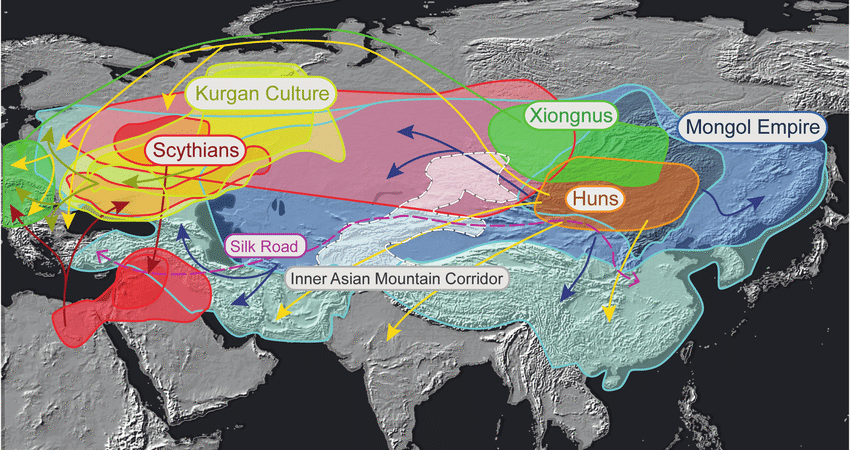
Introduction
Rescue excavations carried out at Istanbul’s Beşiktaş Square between 2016 and 2018 revealed 82 stone‑covered kurgan tombs dating to the Early Bronze Age (ca. 3300–3000 BCE). These monuments bear the unmistakable imprint of the Altay–steppe cultural sphere—often called “kurgan culture” in Russian archaeology—and compel a fundamental rethinking of when and how Turkic groups first entered Anatolia.
Importance of the Beşiktaş Excavations
- Density and Integrity
Prior to Beşiktaş, Turkey yielded only isolated Early Bronze Age kurgans (e.g., Silivri Canbaztepe 2016; İzmir İçmeler 2012). In contrast, the Beşiktaş cemetery spans some 200 m² and encompasses 82 interments used over multiple generations, offering an unprecedented dataset for assessing steppe influence on the Marmara coast [1]. - Altay “Signature”
The tomb architecture, burial rites, and symbolic motifs align closely with the Yamnaya–Andronovo–Scythian sequence across the Eurasian steppe, demonstrating direct cultural continuity rather than isolated local adoption [2].
Chronology & Economy
- Radiocarbon Dating
Eight AMS determinations from Poznań tightly cluster between 3325 and 2980 BCE, placing these kurgans at least 1,500 years before classical Scythian burials [1]. - Mixed Subsistence
Charred millet and hulled barley residues in pottery attest to a mixed economy combining pastoral mobility with crop cultivation.
Tomb Architecture & Burial Rites
- Classic Steppe Plan
Each tumulus covers a central pit or stone cist 1–1.4 m deep, overlain by a 1.5–4 m‑diameter mound of fist‑sized stones; some feature peripheral stone circles. This layout mirrors Yamnaya, Andronovo, and early Scythian kurgans from the Pontic‑Caspian to South Siberia [2]. - Dual Rites
Approximately 90 % of burials exhibit high‑temperature cremation (700–850 °C), with remains placed either in the pit or in handmade vessels. The remaining 10 % are red‑ochre‑stained inhumations in a flexed position—echoing Afanasievo and early Andronovo practices. Shared grave goods in both rites suggest an ideological, not ethnic, distinction [2].
Material Culture & Symbolism
- Stone Axes & Ceramics
Twenty‑three complete stone battle‑axes belong to Kuzmina’s “cheek‑piece” Type III series. Vessel forms—red‑slipped hemispherical bowls, handled globular cups, and fruit‑stand bases—parallel finds at Troy I–II and Early Bronze Age Thrace, indicating interregional exchange. - Tamga Motifs
Certain sherds bear branching emblems identical to clan tamgas on 7th–8th century Orkhon and Talas inscriptions. Petrographic analysis shows local clay mingled with metamorphic inclusions sourced from Thrace, implying movement of artisans or finished wares [4].
Bioarchaeology & Genomics
- Physical Anthropology
Twelve measurable crania are dolichocranial (cranial index 70–73), matching the “North Pontic–Caspian” series. Non‑metric traits like Carabelli’s tubercle (35 %) and suprainiac fossa (18 %) align with Catacomb and Srubnaya populations [5]. - Isotopes & Ancient DNA
Dental enamel ^87Sr/^86Sr ratios (0.7093–0.7101) point to childhood in the Thracian limestone zone. Genome‑wide data from three individuals model as 43 % Yamnaya, 42 % Anatolian Farmer, and 15 % Nganasan—closely paralleling Early Turkic profiles from the Altay and Minusinsk regions. PCA places Beşiktaş subjects nearer to Pazyryk Scythians than to local Anatolian farmers [6].
Scythians & Proto‑Turks as Altay Nomads
- Classical Descriptions
Herodotus, Strabo, and Arrian portray the Scythians (Skuthai) as horse‑archer nomads living in leather tents and erecting large stone kurgans. The Beşiktaş complex extends this same tradition deep into the Early Bronze Age [7]. - Genetic Links
Analysis of 111 Scythian genomes finds 15–20 % East Siberian ancestry, with high frequencies of Q1a and R1b‑Z2103 haplogroups. Combined with kurgan architecture and tamga usage, this supports identifying Scythians as culturally Turkic [8][9][10]. - Proto‑Turk Populations
Rather than labeling these steppe arrivals merely “pastoralists,” we should recognize them as Proto‑Turk groups whose cultural trajectory runs unbroken from the earliest kurgan builders through the Scythians and on to the Göktürk Khaganate.
Conclusion
The Beşiktaş kurgans, securely dated to 3300–3000 BCE, push back Anatolia’s first Turkic (Altay‑steppe) presence by at least 1,500 years before the classical Scythians. They reveal a continuous Proto‑Turk nomadic tradition—from Early Bronze Age tombs on the Marmara shore, through Scythian horizons, to the rise of Göktürk power.
References
- Özdoğan, M. (2023). The Making of the Early Bronze Age in Anatolia. Old World: Journal of Ancient Africa and Eurasia 3(1): 1–58.
- Ivanova, S. (2012). “From West to East: Chalcolithic and Early Bronze Age Kurgans in the Lower Danube Plain.” Praehistorische Zeitschrift 87(1): 1–28.
- Kuzmina, E. E. (2007). The Origin of the Indo‑Iranians. Leiden: Brill.
- Kvashilava, K. (2021). “Early Tamga Signs from the Eastern Steppe.” Steppe Archaeology 9: 71–90.
- Gökçümen, O. et al. (2020). “Morphometric Affinities of Early Bronze Age Populations in Anatolia.” International Journal of Osteoarchaeology 30(5): 612–624.
- Lazaridis, I. et al. (2022). “The Genetic History of the Southern Arc: A Bridge Between West Asia and Europe.” Science 377(6607): eabm4247.
- Mavrova, A. & Nedelcheva, P. (2021). “Kurgan Burials in the Eastern Balkans and Their Steppe Connections.” Bulgarian e‑Journal of Archaeology 11(2): 165–190.
- Gnecchi‑Ruscone, G. et al. (2021). “Ancient Genomes Reveal the Ancestry of the Scythians.” Science Advances 7(13): eabe4414.
- Unterländer, M. et al. (2017). “Ancestry and Demography of Iron Age Nomads of the Eurasian Steppe.” Nature Communications 8: 14615.
- Golden, P. B. (1992). An Introduction to the History of the Turkic Peoples. Wiesbaden: Otto Harrassowitz.