Imagine the crackle of burning homes on a starlit night in the Peloponnese, 1821. A terrified mother clutches her child as triumphant rebels storm Tripolitsa, swords wet with blood. Fast-forward to 1995: a Bosnian father is marched away under a UN banner, never to return, while a general declares “Time for revenge against the Turks.” Who are these “Turks” scattered across Balkan battlefields and graves? They are not invaders but native sons and daughters – Muslims of Turkish heritage (and often, any Muslims misidentified as “Turks”) – who for centuries have been systematically massacred, exiled, and erased. This article explores their largely forgotten tragedy. With a touch of irony and an unwavering humanitarian lens, we will journey through the Greek War of Independence, the Russo-Turkish War, the Balkan Wars, World War II, Communist Bulgaria’s campaigns, the Bosnian War, and the ongoing discrimination today. Each chapter unveils unspeakable cruelty – and a shameful silence. How did religious zeal and nationalist fervor turn entire communities into targets for genocide? And why, even now, do the ghosts of these atrocities still haunt courtrooms and human rights reports? The answers lie in the blood-stained soil of the Balkans, where history, faith, and identity collided in deadly fashion.

The Greek War of Independence (1821–1829): Holy War or Holy Terror?
In the spring of 1821, Orthodox Christian Greeks rose against Ottoman rule in what would be lauded as a war of liberation. But beneath the heroic folklore lies a gruesome reality: the conflict quickly morphed into a “brutal war of religion and race,” as even some Greek historians admit [1]. What began as a bid for freedom took on the flavor of a medieval crusade – with local imams and entire Turkish (Muslim) villages as the victims. Contemporary observers described the early phases of the revolt not as pitched battles but as “a series of opportunist massacres” of defenseless Turks [2]. Infamous among these was the fall of Tripolitsa (Tripoliçe) in the Morea (Peloponnese) in 1821, where the carnage defies imagination.
Scene – Tripolitsa, 1821: After a siege of several months, the once bustling Ottoman provincial capital – packed with Muslim Turkish residents, Albanian Muslims, and Jews seeking shelter – fell to the Greek rebels. What followed was indiscriminate butchery. An estimated 6,000–15,000 Muslim and Jewish civilians were slaughtered in a frenzy of revenge [3]. Eyewitnesses recount that Greek fighters swarmed through the streets, “massacring everyone without discriminating age or gender; horrendous scenes including fires, bullets, pitiful screams and terror” filled the city [4]. One Greek commander, Theodoros Kolokotronis, admitted that “I gave the order to kill everyone in Tripolitsa” – and indeed his men tried. The town’s Muslim judge was captured, tortured and burnt alive as a grim spectacle [5]. Not even those who surrendered or sought refuge were spared: about 2,000 women and children who had fled outside the city were later tracked down and viciously slain by insurgents who felt not enough blood had been shed, according to one chronicle [4][6]. This was not an isolated breakdown of discipline, but rather the plan. As one historian put it, by the end of 1821 the Turks of the Peloponnese had been “summarily extirpated” – essentially wiped out [1][7].
The radical religious dimension of the Greek revolt cannot be overstated. The uprising was often framed by its leaders as a holy cause to reclaim a Christian land from “infidels.” Slogans and songs invoked Orthodox Christian vengeance for “400 years of Turkish yoke.” In some cases, priests themselves incited or even led mobs. The violence took on an exterminatory character: British historian William St. Clair famously wrote that the Greek Revolution “was hardly a war at all… but largely a series of opportunistic massacres” in which unarmed Muslim families paid the price of being “the weaker community and the wrong religion” [2]. By war’s end, virtually no Muslims were left in the new Greek state [8]. British diplomats reported that entire Turkish quarters and villages had been emptied; bones littered the roads [9][10]. Of the 80,000 Turks in the Morea before 1821, almost none remained by 1829 – they had been either killed or driven out [7]. One Ottoman archive describes piles of severed heads and corpses, a “genocidal process” that only ended, St. Clair notes wryly, “when there were no more Turks to kill” [8].
The new Greek state, under European patronage, insisted on the permanent exclusion of Muslims. In negotiations leading to independence, it was “persistently prioritized” that Turks could not live alongside Greeks – all remaining Ottoman Muslims were to be expelled from the Morea [11]. The few survivors who hadn’t been slain were thus forced into exile, their properties confiscated or destroyed. In a cruel twist of memory, Greece to this day celebrates 1821 as a heroic birth of the nation, while the massacre of Tripolitsa is glossed over or even perversely exalted. A 19th-century poem by Dionysios Solomos that praised the slaughter of Turks at Tripolitsa was adopted as the Greek national anthem (and is still used by Greece and Greek Cyprus) [12]. Such veneration of a bloodbath – literally enshrining “forty thousand innocent souls massacred” in song [12] – encapsulates the bitter irony. What Greek lore hails as a holy war of liberation was, for Turkish communities in Greece, closer to holy terror. The Greek War of Independence set a tragic template: in the Balkans, religious identity and emerging nationalism entwined to label Muslim Turks as existential enemies, justifying atrocities in the name of freedom.
The 1877–78 Russo-Turkish War: “Liberation” Unleashes Annihilation
Decades later, another so-called liberation unfolded – this time in the Balkans’ eastern reaches. The Russo-Turkish War of 1877–1878, fought ostensibly to free Bulgarian Christians from Ottoman rule, became a pretext for large-scale slaughter of Turks (and other Muslims) in Bulgaria and beyond. Russian imperial troops, allied with Bulgarian nationalist insurgents, swept through Ottoman territories in Europe with religious vengeance on their lips. The result for the region’s Turks was catastrophic: entire Muslim towns were put to the sword, and an exodus of Biblical proportions began. While Europe cheered the defeat of the “Turk,” few noticed the bleeding trail of Turkish villagers – mostly peasants – fleeing for their lives.
It all began with the April Uprising of 1876 in Bulgaria. In that revolt, Bulgarian rebels first massacred Muslim villagers in several areas, a fact largely overlooked in Western reports that focused only on Ottoman reprisals [13]. When Russia invaded in 1877 “ostensibly to save the Christians,” it opened the floodgates of ethnic cleansing [13]. As Russian armies and Bulgarian volunteer units advanced, they engaged in systematic atrocities against Muslim civilians. Villages were torched and people butchered in an atmosphere of religious and ethnic hatred. Contemporary British diplomats documented how, in one region, Muslim inhabitants were disarmed by the Russians and then massacred by Bulgarian irregulars armed with those very weapons [14]. In countless towns from the Danube to the Balkans, reports came of mass burnings, tortures, and massacres of Turks – often entire communities wiped out in days. One British report noted that in a single district, “96 of 170 Turkish houses were burned” and that Russian Cossacks participated in torturing and killing hundreds of Muslim men [14][15]. The pattern was chillingly methodical: conquer, collect weapons from the local Muslim populace (promising safety), then unleash the armed Christian volunteers to exact revenge. According to Ottoman accounts, in Kızanlık some 400 Muslims were murdered in cold blood by Russian/Bulgarian gangs [14]. Women, children, and the elderly were not spared – many were slain or died of exposure as they fled burning villages.
The scale of the carnage was immense. Modern historical estimates suggest that up to 400,000 Muslim civilians were massacred in 1877–78 in the areas that became Bulgaria [16]. Justin McCarthy, an American demographer-historian, notes that this constituted about 17% of all Muslims in Bulgaria, and that an additional 34% of the Muslim population was expelled during the war [17]. Indeed, by war’s end well over a million Turkish and other Muslim refugees – men, women, and children – had trudged through winter snows to Ottoman-held territory, in what a British observer called a “silent exodus” [18]. Many perished from hunger and disease along the way, their suffering largely invisible to a Europe fixated on Christian liberation. One historian bluntly states: “It is estimated that up to 1.5 million were displaced and/or became refugees” as the Ottoman Balkans were emptied of Muslims in those years [16]. The Turkish term for this period, “93 Harbi” (War of ’93, referring to the Islamic calendar year), carries memories of devastation – families separated, entire districts depopulated.
Subtle sarcasm underlies the term “liberation” often used for Russia’s role. For the Muslim Turks, this was anything but liberation; it was annihilation. Even some European voices at the time grasped the hypocrisy. The British statesman William Gladstone had decried Ottoman brutality as the “Bulgarian Horrors,” but as Prof. Justin McCarthy wryly points out, Western publics “never considered Muslim deaths” in their outrage [13][17]. The Russians marched under the banner of Christian salvation, yet left behind burned mosques, desecrated graves, and butchered communities. An American journalist in 1878 described deserted Muslim villages “with doors wide open, tables still set with food – and not a living soul, only corpses” (reports that barely made the papers). By the Treaty of Berlin (1878), a new Bulgarian principality emerged, free of Ottoman rule – and largely empty of Turks.
One telling anecdote: A Russian general, upon seeing refugees clogging the roads to Istanbul, supposedly remarked that “the Crescent is finally retreating”. Indeed it was – borne on the shoulders of starving villagers. This wave of ethnic cleansing in 1877–78 is sometimes called “the first modern genocide of Muslims in Europe”, though it rarely receives the same recognition as contemporaneous atrocities against Christians. In the end, Bulgarian and Russian forces achieved what they sought: a Bulgaria without Turks. For the Balkan Turks, it was yet another chapter written in blood and tears, a prelude to even darker days ahead.
The Balkan Wars (1912–1913): Ethnic Cleansing in the Name of Nationhood
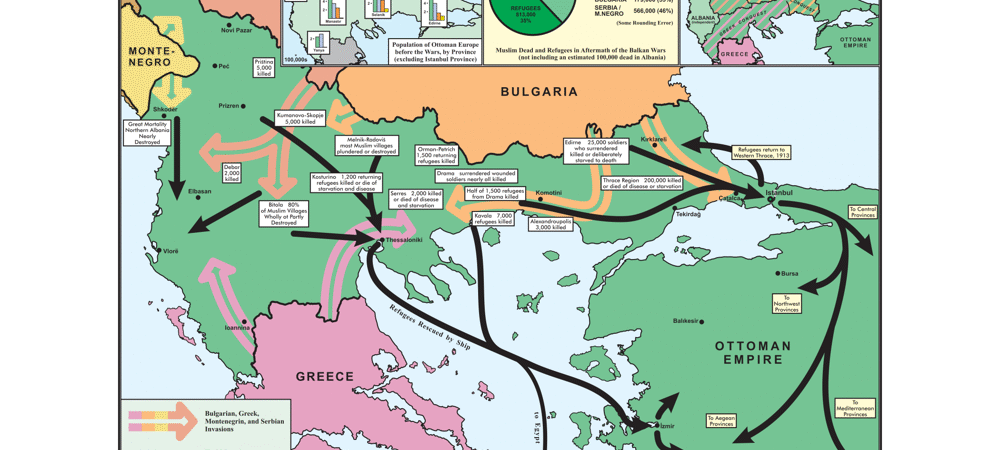
In 1912, a coalition of Balkan Christian states (Bulgaria, Greece, Serbia, and Montenegro) launched the Balkan Wars to grab the remaining European territories of the weakening Ottoman Empire. It was painted as the final freeing of the Balkans from Ottoman “tyranny.” Instead, it became a frenzy of ethnic cleansing that one Carnegie Endowment report in 1913 called “a return to the methods of the dark ages” [19]. For Ottoman Muslims – predominantly Turks and also Albanian Muslims – these wars meant massacres, rapes, and the wholesale burning of villages, carried out with astonishing zeal. The Carnegie Commission’s investigation concluded that “the members of the Balkan League committed genocides and other kinds of mass violence” against Muslim populations of the peninsula [19]. Indeed, these campaigns have been termed an “unrecognized genocide” of Ottoman Muslims, as hundreds of thousands were killed or expelled [19][20].
“Fire and Sword” – Macedonia, 1912: Consider one account from a British correspondent: as Serbian and Greek forces advanced into Ottoman Macedonia, “the Moslem villages were systematically burned by their Christian neighbors” [21]. In Monastir region (present-day Bitola, North Macedonia), 80% of the Muslim villages were burned to ashes by the Serbian and Greek armies [21]. A harrowing scene in the town of Doiran was witnessed by an observer: “I saw an old man of eighty lying in the street with his head split open, and the dead body of a boy of thirteen beside him. About thirty Muslims were killed that day” [22]. Such episodes were repeated countless times. Entire communities were “wiped off the map.” In the Kosovo and Sandžak regions, Serbian forces reportedly exterminated villages, with estimates that up to 120,000 Albanian Muslims were killed in the course of a few months [23]. Soldiers and irregular bands showed no mercy – women were violated, imams were bayoneted in their mosques, and infants were sometimes thrown into rivers.
Religious fury was also evident. Although nationalism was the driving ideology, the violence had a pronounced religious cast. Christian militias, some bearing crosses or icons, attacked mosques, tearing them down or converting them after expelling congregants. During the Balkan Wars, dozens of historic mosques were desecrated or destroyed – in some regions, none were left standing [24]. Cemeteries were dug up, and Ottoman Muslim cultural sites obliterated, as if to expunge even the memory of Turkish presence. This campaign was so effective that by 1914, Western Thrace, Macedonia, Kosovo, and much of Bulgaria had almost no Turks left in rural areas.
The human toll of the Balkan Wars is staggering. According to McCarthy’s analysis, roughly 27% of the Muslim population in Ottoman Europe died from violence, hunger, or disease as a direct result of the wars [20]. This implies that out of about 2.5 million Ottoman Muslims in the affected regions, at least 600,000 died in 1912–13. Moreover, over 1 million were driven out as refugees, many to Istanbul and Anatolia [20]. In total, about 1.5 million people of the Turkish/Muslim communities were killed or expelled – a demographic catastrophe on par with better-known tragedies.
World War II: Chetnik “Ethnic Cleansing” – A Final Solution for the “Turks”
The horrors did not cease with the dawn of the 20th century’s world wars. During World War II, while Nazi Germany perpetrated the Holocaust against Jews, in the Balkans another genocidal campaign took place under the fog of war – this time against the Muslim Slavs (Bosniaks) of Bosnia and Sandžak, who were often derisively labeled “Turks” by Serbian nationalists. The perpetrators were the Chetniks, a Serb ultra-nationalist and royalist guerrilla force led by Draža Mihailović. Their goal: create an ethnically pure Greater Serbia, “cleaned” of non-Serbs – especially Muslims and Croats. In pursuit of this, Chetnik units systematically massacred Muslim villagers between 1941 and 1945, in what historians have recognized as a genocide of the Bosniak people [25].
The Chetnik leader’s own words make the intent clear. In February 1943, Pavle Đurišić, one of Mihailović’s commanders, proudly reported “the complete extermination of the Muslim population in districts Foča, Pljevlja, Čajniče and Avtovac”, listing thousands of women and children among the dead. His report, chilling in its precision, detailed village after village cleansed of “Turks”. Muslim men were killed outright, women and children driven into the winter and often left to die. Churches rang bells in some Serb villages to celebrate these “victories” over the infidel. The Chetniks referred to their anti-Muslim operations explicitly as “cleansing” (čišćenje), decades before the term would become infamous in the 1990s [26].
The scale of Chetnik violence was staggering. Research by historian Vladimir Dedijer and others found that at least 50,000 Bosniak Muslims were murdered by Chetniks in eastern Bosnia and Herzegovina, and a further 5,000+ in the Sandžak region (now part of Serbia and Montenegro) [25][27]. Many victims were the elderly, women, and children in rural communities who had no means of defense. Chetnik units would encircle a Muslim village at dawn, set houses on fire, and slaughter inhabitants as they ran out. In one notorious atrocity in Višegrad (Eastern Bosnia), June 1943, hundreds of Muslim women and children were locked in houses which were then torched – echoes of methods used in medieval times. Survivors’ testimonies recall Chetnik fighters taunting residents with shouts of “Turks, your time has come!” before executing them.
By the war’s end, whole Muslim communities in places like Foča, Srebrenica, and Zvornik had been erased – a prelude to the 1990s. Yugoslavia’s post-war communist government buried these atrocities in silence, partly to maintain “Brotherhood and Unity” and partly because Muslims had no voice in the corridors of power. Thus, this genocide never received a Nuremberg trial or much global acknowledgement. Yet its legacy lived on in collective memory, especially among Serbian nationalists who saw it not as crime but as unfinished business.
It is telling that when Ratko Mladić led Bosnian Serb forces into Srebrenica in July 1995, he echoed the Chetnik ethos. “Here we are in Srebrenica on this 11 July 1995… The time has finally come to take revenge on the Turks.” [28] His choice of words was deliberate: it signaled to his troops that the forthcoming mass murder was a historic reckoning – a justified act. That Mladić used centuries-old tropes in a modern genocide shows how alive the Chetnik worldview remained.
The “Revival Process” in Communist Bulgaria (1984–1989): Erasing Identity, Erasing Humanity
Even after the guns of WWII fell silent and new socialist regimes ostensibly championed equality, old ghosts lingered. In Communist Bulgaria, those ghosts took the form of a campaign in the 1980s that can only be described as cultural genocide against the Turkish minority. With Orwellian doublespeak, the regime of Todor Zhivkov dubbed it the “Revival Process,” claiming it was helping Turks “rediscover” their Bulgarian identity. In truth, it was a violent attempt to wipe out Turkish language, religion, and culture – to make Turks literally disappear from Bulgaria’s future.
A Dark Christmas, 1984: In the predominantly Turkish town of Momchilgrad, on December 26, 1984, Turkish villagers gathered peacefully to protest rumors that the government would force them to change their names. “I wasn’t afraid because we were innocent,” recalls Sevginar Mahmud, who was 18 at the time [29]. Security forces and soldiers descended with water cannons, batons, and eventually live ammunition. “They started shooting… we had nothing, not even sticks,” she says. She witnessed her friend Ferishte get shot in the back as they fled [29]. At the hospital, she saw a 17-month-old baby girl, Turkyan, brought in dead – shot through the head [29].
Once the community was subdued by force, the regime moved systematically to erase Turkish identity. Within three months, authorities had forcibly changed the names of over 800,000 Turkish and Muslim people – compelling them to adopt Slavic Bulgarian names [30]. The Turkish language was banned in public, mosques were shuttered, and imams silenced. Turkish names were chiselled off gravestones. Even newborns had to be given Bulgarian names.
Facing internal unrest and international pressure, the Bulgarian regime’s final act was a massive expulsion. In the summer of 1989, under the ironically named policy “The Big Excursion,” Bulgaria opened its border and expelled approximately 320,000 ethnic Turks to Turkey [31]. This was Europe’s largest forced migration since World War II, uprooting roughly a third of Bulgaria’s Turkish minority in a matter of weeks. Families hastily packed a few bags, often leaving homes and livestock behind, and crossed into Turkey as refugees.
Bulgaria’s dictator fell later that year, and the new government stopped the overt persecution, even allowing some Turks to return. But justice was never served – no one was held accountable for the killings and cultural erasure. The scars of the “Revival Process” linger: mistrust of authorities, cultural loss, and a reduced population.
The Bosnian War (1992–1995): “Turks” Targeted in Europe’s Worst Atrocity Since the Holocaust
The disintegration of Yugoslavia in the 1990s unleashed virulent ethnic nationalism once more, and with it the old trope of identifying Balkan Muslims as the alien “Turks.” Nowhere was this more deadly than in Bosnia and Herzegovina, where Bosnian Muslim communities (Bosniaks) – despite being South Slavs by ethnicity – were demonized as descendants of the Ottoman Turks and treated as fair game for extermination.
The Bosnian War (1992–95) witnessed the return of concentrated genocide on European soil, culminating in the Srebrenica massacre of July 1995, in which over 8,000 unarmed Bosniak men and boys were systematically executed by Bosnian Serb forces [32]. The rhetoric used by the perpetrators explicitly cast these victims as “Turks.” This final tragic chapter (to date) of anti-Turkish violence in the Balkans underscores how powerful and poisonous the historical mythos can be: medieval grudges weaponized in modern conflict.
From the outset of the war, Bosnian Serb leaders like Radovan Karadžić and General Ratko Mladić invoked historical vengeance. They propagated a narrative that Serbs needed to avenge the 14th-century Battle of Kosovo and centuries of Ottoman rule by crushing Bosnia’s Muslims. Serbian media and soldiers routinely referred to Bosniaks as “Turci” (Turks) or “balije” (a derogatory term), effectively denying their identity as a native people.
The Srebrenica Genocide is emblematic. This UN-declared “safe area” fell to Mladić’s forces on July 11, 1995. Mladić, as noted, strolled into town flanked by TV cameras and declared, “We give this town to the Serb people… after many rebellions, the time has come to take revenge on the Turks.” [33] His choice of words was deliberate: it signaled to his troops that the forthcoming mass murder was a historic reckoning – a justified act. Over the next several days, more than 8,000 Bosniak Muslim men (from teenagers to elderly) were executed at various sites, their bodies dumped in mass graves that were later bulldozed and re-buried in a cover-up [32]. Survivors described Serb soldiers taunting them during captivity with lines like “You wanted Ottoman rule again? Here’s your Turkish fate.”
The human toll of the Bosnian War on Muslims was immense. Of the approximately 100,000 people killed in the war, around 80% were Bosniak Muslims, including about 30,000 civilians (many of them at the hands of Serb forces) [34]. Over 1.3 million Bosniaks were driven from their homes, their communities devastated in a campaign of terror known benignly as “ethnic cleansing.” In places like Foča, virtually all mosques were dynamited – not a single one was left standing.
A poignant testimony comes from a Bosniak woman, Fatima (name changed), who survived a mass execution by crawling out from under corpses. “They called us Turks and laughed as they shot my father and brothers,” she recalled. “I lay in their blood and pretended to be dead. I still hear those laughs in my nightmares.”
Ongoing Discrimination in the 21st Century: The Silent Struggle of Turkish Minorities
Even today, long after the wars and pogroms, Turkish minorities across the Balkans continue to face discrimination and pressure – not mass murder, but subtler forms of cultural suppression and rights denial. From Greece’s Western Thrace to North Macedonia’s Turkish communities, from Bulgaria’s political scene to Kosovo’s schools, Turks navigate a daily reality of marginalization.
Greece (Western Thrace)
Home to about 100,000–120,000 Muslim Turks, protected by the 1923 Treaty of Lausanne, yet the Greek state refers to them only as the “Muslim minority” [35]. The use of the word “Turkish” in association names has been banned; several historic Turkish associations were forcibly dissolved [36]. The European Court of Human Rights ruled in 2007–2008 that Greece violated their rights, yet Athens has refused to implement those judgments [36]. Religious autonomy is undermined by state-appointed muftis replacing community-elected ones. Minority schools exist but face resource shortages and quotas restricting Turkish students’ university access.
Bulgaria
Since the fall of communism, overt persecution has stopped, but far-right parties periodically stoke anti-Turkish rhetoric. Hate incidents include attacks on mosques and political rallies with slogans against Turks. Employment discrimination and underfunding of Turkish-majority municipalities remain concerns [37].
North Macedonia and Kosovo
Turks have official minority status and access to education in their language, but often face assimilation pressure and political underrepresentation [38]. In Kosovo’s Prizren, Turkish culture is vibrant, yet demographic decline and reduced political clout worry community leaders.
Common Issues Across the Region
- Denial of ethnic identity (labeling them only “Muslims” rather than Turks)
- Language suppression in public services and education
- Obstacles to mosque restoration or building permits
- Limited representation in state institutions
- Hate speech in media and politics
Human Toll of Atrocities Against Turks in the Balkans (19th–21st Centuries)
| Event & Time Period | Estimated Killed | Estimated Displaced / Expelled | Perpetrators |
|---|---|---|---|
| Greek War of Independence (1821–1829) | ~20,000–30,000 Muslims (Turks) massacred in Greece [1][2] | ~50,000+ expelled or forced to flee [5][7] | Greek revolutionaries (irregulars, militias, armed peasants) driven by radical religious nationalism |
| Russo-Turkish War (1877–1878) | ~200,000–300,000 Muslims killed [16][17] | ~500,000–1,200,000 expelled/fled [16][18] | Russian Imperial Army, Bulgarian irregulars, local Christian mobs |
| Balkan Wars (1912–1913) | ~600,000 Muslims killed [20] | ~1,000,000–1,200,000 expelled [20] | Armies of Bulgaria, Serbia, Greece, Montenegro; paramilitaries |
| WWII – Chetnik Genocide (1941–1945) | ~55,000–75,000 Muslims killed [25][27] | Tens of thousands displaced | Serbian Chetnik forces under Draža Mihailović |
| Communist Bulgaria’s “Revival Process” (1984–1989) | ~100+ killed [29][30] | ~320,000 expelled in 1989; hundreds of thousands forcibly assimilated [31] | Bulgarian Communist regime |
| Bosnian War (1992–1995) | ~32,000 Bosniak civilians killed, incl. 8,000+ in Srebrenica [32][34] | ~1,300,000 Bosniaks displaced [34] | Bosnian Serb forces, paramilitaries |
Conclusion: Never Again – and Never Forget
From the smoking ruins of Tripolitsa in 1821 to the mass graves of Srebrenica in 1995, the Turks of the Balkans have been the targets of unimaginable cruelty. The final takeaway is as poignant as it is pressing: these atrocities were not collateral damage, they were intentional attempts to erase a people. In each era, the survivors carried the scars into the next generation, and the persecutors carried forward the narratives that justified the violence.
The recurring use of “Turk” as a slur or synonym for enemy – whether against ethnic Turks, Albanian Muslims, or Bosniaks – underscores how historical myths can be weaponized for genocide. The irony is sharp: movements celebrated as “liberations” often relied on massacres, expulsions, and cultural erasure.
Today, Turkish minorities in the Balkans are no longer under open physical threat, but subtle and systemic forms of discrimination persist. Language rights, religious autonomy, and even the right to call themselves “Turkish” remain contested in some states. Their survival, culture, and resilience are in themselves a quiet victory over centuries of efforts to destroy them.
“Never again” is not just a slogan; it is a responsibility. Forgetting enables repetition. Remembering – in detail, and with names and numbers – is the first defense against future atrocities.
References
- St. Clair, W. (1972). That Greece Might Still Be Free: The Philhellenes in the War of Independence. Oxford University Press.
- Brewer, D. (2011). The Greek War of Independence: The Struggle for Freedom from Ottoman Oppression and the Birth of the Modern Greek Nation. Overlook Press.
- Finlay, G. (1861). History of the Greek Revolution. Blackwood and Sons.
- Vakalopoulos, A. (1970). History of Modern Hellenism. Thessaloniki: Institute for Balkan Studies.
- Koliopoulos, J. S., & Veremis, T. M. (2002). Greece: The Modern Sequel. Hurst & Company.
- Woodhouse, C. M. (1975). The Philhellenes. Hodder and Stoughton.
- Shaw, S. J., & Shaw, E. K. (1977). History of the Ottoman Empire and Modern Turkey. Cambridge University Press.
- St. Clair, W. (2008). That Greece Might Still Be Free (New ed.). Open Book Publishers.
- Leake, W. M. (1835). Travels in Northern Greece. J. Rodwell.
- Wace, A. J. B., & Thompson, M. S. (1914). Nomads of the Balkans. Methuen & Co.
- Gallant, T. W. (2015). Modern Greece: From the War of Independence to the Present. Bloomsbury Publishing.
- Mackridge, P. (2009). Language and National Identity in Greece, 1766–1976. Oxford University Press.
- Jelavich, B. (1983). History of the Balkans. Cambridge University Press.
- British Foreign Office. (1878). Reports from Her Majesty’s Consuls on the Condition of the Mussulman Population in Bulgaria. London: HMSO.
- Stanford, W. (1879). The Eastern Question. London: Henry S. King.
- McCarthy, J. (1995). Death and Exile: The Ethnic Cleansing of Ottoman Muslims, 1821–1922. Darwin Press.
- Karpat, K. (1985). Ottoman Population, 1830–1914. University of Wisconsin Press.
- Ubicini, A. (1876). Letters on Turkey. Chapman & Hall.
- Carnegie Endowment for International Peace. (1914). Report of the International Commission to Inquire into the Causes and Conduct of the Balkan Wars. Washington, D.C.
- McCarthy, J. (1995). Death and Exile (pp. 150–170). Darwin Press.
- Durham, M. E. (1905). The Burden of the Balkans. E. Arnold.
- Brailsford, H. N. (1906). Macedonia: Its Races and Their Future. Methuen & Co.
- Schmitt, O. J. (2012). Kosovo: A Short History. C. Hurst & Co.
- Kiel, M. (1990). Ottoman Architecture in Albania, 1385–1912. Research Centre for Islamic History, Art and Culture.
- Hoare, M. A. (2013). The Bosnian Muslims in the Second World War. Oxford University Press.
- Pavlowitch, S. K. (2008). Hitler’s New Disorder: The Second World War in Yugoslavia. Columbia University Press.
- Dedijer, V. (1992). The Yugoslav Auschwitz and the Vatican. Prometheus Books.
- International Criminal Tribunal for the former Yugoslavia (ICTY). (2001). Prosecutor v. Radislav Krstić (Trial Judgment).
- Amnesty International. (1986). Bulgaria: Imprisonment of Ethnic Turks for Peaceful Dissent. AI Index EUR 15/05/86.
- Human Rights Watch. (1989). Destroying Ethnic Identity: The Turks of Bulgaria.
- Kamusella, T. (2018). Ethnic Cleansing During the Cold War: The Forgotten 1989 Expulsion of Turks from Communist Bulgaria. Routledge.
- United Nations. (1999). Report of the Secretary-General pursuant to General Assembly resolution 53/35: The fall of Srebrenica.
- Hodžić, R. (2012). Bosnia: The haunting legacy of Ratko Mladić. Al Jazeera.
- Bose, S. (2002). Bosnia after Dayton: Nationalist Partition and International Intervention. Oxford University Press.
- Minority Rights Group International. (2023). Turks in Greece.
- European Court of Human Rights. (2008). Bekir-Ousta and Others v. Greece.
- European Commission. (2024). Rule of Law Report: Bulgaria.
- OSCE High Commissioner on National Minorities. (2021). Report on Minority Rights in the Western Balkans.