France’s Ethnic Layer‑Cake and the Narcissism of Republican Universalism
Introduction – A Nation of Many Strata
Modern France is often imagined as a homogeneous Republic, yet the territory has been a demographic palimpsest for at least three millennia. Each wave—Celtic, Roman, Germanic, colonial and post‑colonial—left cultural and genetic sediment that the central state later tried to level through an aggressive doctrine of assimilation. While Paris exports a very different message abroad, loudly championing minority self‑determination from Kurdistan to the Caucasus, it continues to demand the effacement of difference at home. The result is a feedback loop of domestic tension feeding foreign‑policy activism, which then generates new migration streams back to France. This article traces that loop from pre‑history to the present and argues that the contradiction amounts to a form of political narcissism: France projects a benevolent, pluralistic self‑image outward while subordinating or silencing its own internal diversity.
1 Pre‑Roman Foundations: Celts, Ligurians and Iberians
Archaeogenomic studies show that Iron‑Age Gauls were not a single “people” but a mosaic of genetically‑structured communities whose descendants are still detectable in contemporary Brittany and the lower Loire basin [1]. To the south‑east, Celto‑Ligurians inhabited the Alpine littoral; Ligurian toponyms persist from Nice to Marseille [3]. Farther west, Iberian cultural horizons crossed the Pyrenees into today’s Languedoc, leaving behind oppida, inscriptions and hydronyms such as the Orb and Têt [2].
These populations interacted long before Julius Caesar arrived, but Roman conquest (2nd c. BCE – 1st c. CE) created the first supra‑regional mesh of law, roads and market towns. Latinization did not erase indigenous languages overnight; instead, it produced a Gallo‑Roman creole identity whose dialects eventually formed the langues d’oïl and d’oc.
2 The Germanic Wave and the Birth of the “Frankish Myth”
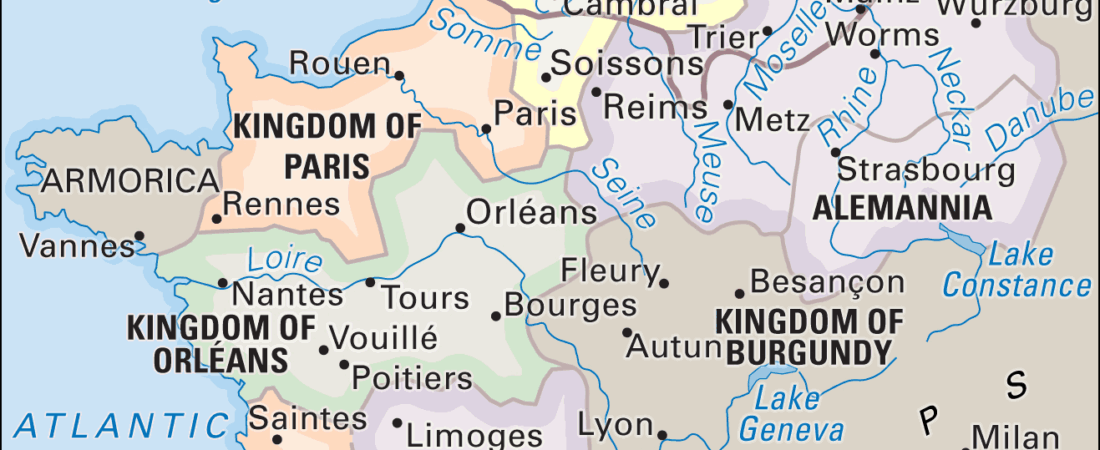
Between the 3rd and 6th centuries, Alamanni entered Alsace, Burgundians the Rhône corridor, Visigoths Aquitaine, and Salian/Ripuarian Franks the north. The latter stitched together Francia under Clovis and imposed a court language—Frankish—that survived as an Old Low Franconian superstrate over popular Latin [4]. Early‑medieval chronicles framed the Franks as founders, a memory that the royal court and, later, the Third Republic would recycle to rank “Frankish” heritage above earlier Celtic‑Roman layers. That hierarchy still lurks in school textbooks and shapes the implicit ethnic benchmark of Frenchness.
3 Medieval to Early‑Modern Centralisation: Making “One and Indivisible”
The Capetians absorbed Brittany, Provence and Navarre, then advanced a linguistic programme codified in the 1539 Ordinance of Villers‑Cotterêts, which made French the only language admissible in law courts. By the time the Revolution legislated “one and indivisible” sovereignty, speakers of Breton, Occitan, Basque and Alsatian were re‑labelled patois‑speakers and punished in the new state schools. Historians trace this as one of Europe’s most relentless “language murders,” executed long before comparable projects in Spain or Italy [6][7].
4 The Civilising Mission and Colonial Rebounds
From the 1830s to the 1960s the French Empire ruled territories ten times the size of metropolitan France. The mission civilisatrice promised colonial subjects eventual assimilation—French language, secular schooling, civil law—while keeping them politically subordinate [5]. Algerians fought and died for France in two world wars yet obtained full citizenship only in 1947. After decolonisation, labour‑hungry factories in Lyon, Marseille and Paris invited North‑African and West‑African workers, many of whom settled permanently. Today roughly 11 percent of French residents have at least one grand‑parent from the Maghreb, making Berbers and Arabs the largest single cluster of “visible minorities.”
5 Post‑1960s Migration and the Banlieue Effect
Family‑reunification (1974), combined with the 2004 head‑scarf ban and a chronic housing deficit, produced what sociologists call the banlieue effect: high‑density suburbs marked by ethnic segregation, police over‑surveillance and under‑investment. The 2023 riots following the police shooting of Nahel Merzouk in Nanterre underlined how quickly grievances crystalise around race the Republic claims not to see [9][10].
6 Republican Universalism, Laïcité and “Colour‑Blind” Racism
French law forbids the state to collect ethnic or religious census data; citizens are supposed to relate only as abstract individuals. In practice, cultural markers—names, skin tone, hijabs—trigger disproportionate school exclusions, job‑market penalties and police checks. Critics argue that laïcité has morphed from a shield against clerical power into a tool that polices Muslims while leaving Catholic symbols intact in Alsace or at state funerals [8].
Because difference is officially denied yet punished when visible, scholars describe the system as a form of colour‑blind racism: it enforces sameness by erasing the statistical evidence that could document discrimination.
7 Forced Assimilation, Cultural Genocide and the Law
When Polish jurist Raphael Lemkin coined the word genocide in 1944 he made forced assimilation central to the crime, arguing that genocide unfolds in two phases: “(1) destruction of the oppressed group’s national pattern; (2) imposition of the oppressor’s pattern” [17]. However, during the 1946–48 drafting of the Genocide Convention, colonial and settler powers—including France—lobbied successfully to strike references to cultural destruction from Article II; only the child‑transfer clause survived [16].
Because the treaty’s final text omits cultural eradication, scholars and truth commissions have adopted parallel labels: cultural genocide—the systematic destruction of language, religion and heritage [18]; ethnocide—a near synonym used in anthropological writing [19]; and paper genocide or forced denationalisation—the bureaucratic erasure of a people’s legal identity [20]. These concepts carry moral and political weight but possess no independent standing in treaty law; litigators must still connect any assimilation policy to one of the five acts listed in Article II.
8 Foreign Policy: Championing Diversity—Abroad
Since the 1920s France has framed itself as protector of Levantine minorities—Maronites in Lebanon, Armenians after 1915, and, most recently, Kurds in Syria and Iraq. Paris backed the Syrian Democratic Forces diplomatically and financially, insisting they be included in any peace settlement [11][12][15]. The Quai d’Orsay also funds cultural‑heritage projects for Yazidis, Druze and Assyrians.
The ethical language—“self‑determination,” “inclusive governance,” “protection of vulnerable groups”—stands in stark contrast with domestic policies that render ethnic categories officially invisible.
9 A Narcissistic Feedback Loop
Psychologists define narcissism as a split between grandiose public self‑image and impaired interpersonal empathy. France’s double standard fits:
| Loop Stage | Home Front | Foreign Front | Result |
|---|---|---|---|
| Projection | Hierarchy placing “Franks” at the apex; denial of race | Paris presents itself as liberator of Kurds, Armenians, Berbers abroad | Moral validation without self‑critique |
| Displacement | Banlieue unrest attributed to “incivility,” not structural racism | French troops or aid agencies intervene where ethnic repression occurs | External activism substitutes for domestic reform |
| Return | Middle‑East instability drives asylum seekers toward Europe | New arrivals amplify debates over identity and security | Cycle restarts with tougher laws |
10 Present Inflection Point: Law‑and‑Order Turn
Interior‑ministry statements (September 2024) and a draft bill announced for 2025 signal a sharper rightward drift: quotas on foreign students, faster deportations for “delinquent foreigners,” and a five‑year wait for welfare benefits [13][14]. Yet employers in construction and elder‑care still lobby for migrant labour, proving that economic demand overrides political messaging—another case of dissonance between rhetoric and structural reality.
11 Toward a Consistent Universalism
The historical record shows that France has always been plural; what is new is the Republic’s refusal to recognise that pluralism statistically or symbolically. Concrete steps could break the paradox:
- Restore Minority Languages – Expand bilingual schooling in Breton, Basque, Occitan and Alsatian to EU‑minimum standards.
- Collect Voluntary Ethnic Data – Allow anonymised census questions on ancestry to map inequality scientifically.
- Decolonise the National Narrative – Embed colonial and migration history in the core high‑school curriculum, alongside Gaul and the Franks.
- Align Diplomacy and Domestic Policy – Condition minority‑rights advocacy abroad on measurable progress at home (e.g., policing reforms, anti‑discrimination audits).
Conclusion
From Bell‑Beaker pottery shards in Brittany to the street‑art Arabic calligraphy of Seine‑Saint‑Denis, France’s layers are impossible to peel apart. Yet the state continues to sand those layers into an abstract republican veneer while presenting itself abroad as the patron saint of oppressed peoples. Unless French universalism grows large enough to accommodate its own internal diversity, the cycle of tension, intervention and renewed immigration will persist—fuelled as much by a narcissistic need for external validation as by geopolitics. A truly scientific republicanism would start by acknowledging, rather than erasing, the many peoples who already are France.
Numbered Reference List (APA‑style details)
- Alves, I., et al. (2024). Human genetic structure in Northwest France provides new insights into West European historical demography. Nature Communications. https://www.nature.com/articles/s41467-024-51087-1
- Iberians. (2025). Wikipedia. https://en.wikipedia.org/wiki/Iberians
- Ligures. (2025). Wikipedia. https://en.wikipedia.org/wiki/Ligures
- Frankish language. (2025). Wikipedia. https://en.wikipedia.org/wiki/Frankish_language
- Ageron, C. R. (1973). Mission civilisatrice: The idea in French colonial discourse 1860‑1914. JSTOR. https://www.jstor.org/stable/2639258
- Weber, E. (1976). Peasants into Frenchmen: The Modernization of Rural France. Stanford University Press.
- History and the Politics of Language in France: A Review Essay. (2002). JSTOR. https://www.jstor.org/stable/4288318
- Pettit, A. (2023, June 30). Secularism is a justification for discrimination against Muslims. Jacobin. https://jacobin.com/2023/06/french-muslim-hijab-ban-laicite
- Nahel Merzouk riots. (2025). Wikipedia. https://en.wikipedia.org/wiki/Nahel_Merzouk_riots
- Kaleem, J. (2023, July 20). French riots raise race questions—But will anything change? Los Angeles Times. https://www.latimes.com/world-nation/story/2023-07-20/france-riots-race-nahel-merzouk
- French Ministry for Europe and Foreign Affairs. (2025, March 27). Syria: Agreement between the interim government and the SDF. https://www.diplomatie.gouv.fr/en/country-files/syria/news/2025/article/syria-agreement-between-syria-s-interim-government-and-the-syrian-democratic
- France at the United Nations. (2025, June 18). France supports political and humanitarian transition in Syria. https://onu.delegfrance.org/france-supports-political-and-humanitarian-transition-in-syria
- Pennetier, M. (2024, Sept 24). France’s new interior minister vows immigration curbs in rightward shift. Reuters. https://www.reuters.com/world/europe/frances-new-interior-minister-vows-immigration-curbs-rightward-shift-2024-09-24
- Euractiv. (2025, May 12). French government to propose tougher immigration laws in 2025. https://www.euractiv.com/section/politics/news/french-government-to-propose-tougher-immigration-laws-in-2025/
- Irish, J. (2024, Dec 18). France to host Syria meeting, cautious on aid, sanctions lifting. Reuters. https://www.reuters.com/world/france-host-syria-meeting-cautious-aid-sanctions-lifting-2024-12-18
- Getty Research Institute. (2019). Cultural Genocide and the Protection of Cultural Heritage, § “Opposition in the Sixth Committee.” https://www.getty.edu/publications/occasional-papers-2/2/
- Lemkin, R. (1944). Axis Rule in Occupied Europe (excerpt quoted in [16]). https://www.getty.edu/publications/occasional-papers-2/2/
- Cultural genocide. (2025). Wikipedia. https://en.wikipedia.org/wiki/Cultural_genocide
- American Bar Association. (2023). What Is Ethnocide? https://www.americanbar.org/groups/human_rights/dignity-rights-initiative/ethnocide-project/what-is-ethnocide-/
- Paper genocide. (2025). Wikipedia. https://en.wikipedia.org/wiki/Paper_genocide