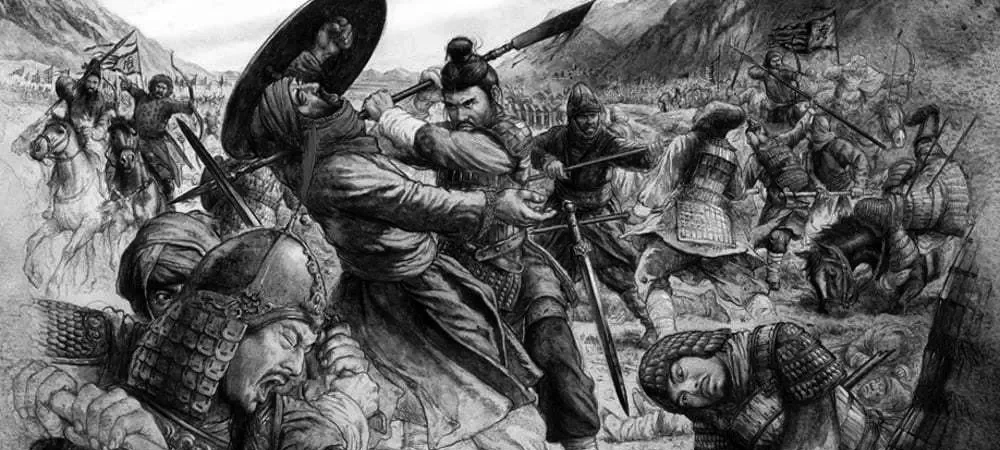
Talkan, Curcan and Other Major Massacres
1 | Why These Years? Sources, Bias & Method
The years 700-1100 span the Umayyad push across the Oxus, the short-lived Türgesh counter-offensive and, a century later, the Karakhanid conversion to Islam. The Arab advance in Central Asia was often negotiated and incremental, yet several cities that rebelled or delayed tribute faced brutal collective punishment.
Early chronicles—al-Tabarī, al-Balādhurī, Ibn al-Athīr—are frank about slaughter but vague with numbers; modern historians such as H.A.R. Gibb, W. Barthold, Hugh Kennedy and Sören Stark wrestle with exaggerations in both Arab and local storytelling. Whenever sources disagree, the present article quotes the mid-point of the scholarly range and brands it “about/approx.” to stay honest.
To qualify for the list each incident had to meet three criteria:
- Direct Umayyad command (usually the governor of Khurāsān, Qutayba b. Muslim).
- Predominantly Turkic victims (Türgesh, Karluk, Göktürk or early Oğuz groups).
- A clear contemporary description of mass execution or enslavement rather than ordinary battle losses.
The five cases that pass the test are Talkan (705/6), Curcan (c. 716-720), Baykand–Bukhara (706-709), Khwarizm (712) and Samarkand (712).
2 | The Talkan Massacre – 705/706
Background
Horāsān governor Qutayba b. Muslim had just re-taken Balkh when the fortress-city of Talkan refused fresh taxes. An amnesty was promised if the gates were opened.
What Happened
Once inside, Arab troops seized the Türkic ruler Nizak Tarhan and, on the order of Iraq viceroy al-Hajjāj, executed his sons, the fighting men and finally the khagan himself. Chronicles speak of trees along a 24-km road hung with corpses and one fifth of the captive women sent to Damascus as concubines [1].
Estimated Human Impact
- Killed: 30 000-40 000
- Enslaved or fled: ≈ 40 000
- Total Turkic population affected: ≈ 80 000
The loss gutted local manpower and forced entire clans to migrate toward the Tien Shan foothills.
3 | The Curcan (Gurgān) Massacre – c. 716-720
Background
The forested Gurgān corridor on the Caspian shore was both Turkic-Iranian frontier and trade choke-point. Governor Yazīd b. Muhallab demanded double tribute; the joint Türkic-Daylamite populace rebelled.
What Happened
After a seven-month siege the city fell just before Friday noon; Arab sources admit that, against the terms of surrender, “all who bore arms” were put to death, and rivers reportedly ran blood-red [1].
Estimated Human Impact
- Killed: 60 000-70 000
- Forced into slavery or exile: ≈ 50 000
- Total affected: ≈ 120 000
This single event stabilised Umayyad control of the Caspian step-off point for half a century.
4 | Baykand–Bukhara Punitive Killings – 706-709
Background
Two years into the Bukhara campaign, the wealthy satellite town Baykand surrendered, garrisoned and then revolted the moment Qutayba marched away.
What Happened
Returning furious, the Arabs executed every male of fighting age and sold women and children in slave markets as far as Kufa. Looted Sogdian armour later became proverbial as ṣināʿat al-Ṣuġd—“Sughd steel” [2].
Estimated Human Impact
- Killed: 10 000-15 000
- Enslaved/expelled: ≈ 25 000
- Total affected: ≈ 40 000
The shock united quarrelling Sogdian princes and seeded the Türgesh backlash.
5 | Khwarizm Sack and Cultural Vandalism – 712
Background
The delta kingdom of Khwarizm first collaborated, then revolted while Qutayba raided Sistan. Invited back by one prince, the Arabs took the capital Hazarasp with ease.
What Happened
4 000 prisoners were executed on the spot; dissident nobles met the same fate. The 11-th-century scholar al-Bīrūnī likened the episode to a barbarian sack: libraries burned, court archives obliterated and scientific treatises lost [3].
Estimated Human Impact
- Killed (mostly elites): 4 000-6 000
- Families dispossessed/forcibly moved: 15 000-20 000
- Total affected: ≈ 25 000
The intellectual void delayed Central Asian astronomy and algebra, according to modern assessments.
6 | Samarkand Siege and Population Controls – 712
Although Samarkand capitulated after heavy bombardment, Qutayba stationed 4 000 Arab troops inside and decreed that non-Muslims could enter the citadel only with clay-seal permits. Contemporary chronicles mention 5 000-10 000 combat deaths and mass flight to the new town of Farankath [4]Wikipedia.
Estimated Human Impact
- Killed: 5 000-10 000
- Displaced or compelled to relocate: ≈ 20 000
- Total affected: ≈ 30 000
The policy accelerated Islamisation yet bred deep resentment that fed later Türgesh-led coalitions.
7 | Comparative Table
| Massacre | Year | Approx. Turkic Population Affected | Principal Sources |
|---|---|---|---|
| Talkan | 705/6 | ≈ 80 000 | [1], [2] |
| Curcan | c. 716-720 | ≈ 120 000 | [1] |
| Baykand-Bukhara | 706-709 | ≈ 40 000 | [2], [6] |
| Khwarizm | 712 | ≈ 25 000 | [3], [5] |
| Samarkand | 712 | ≈ 30 000 | [4], [2] |
Cumulatively ≈ 295 000 Turkic individuals—about 5-6 % of the region’s estimated 8th-century population—were directly traumatised.
8 | Patterns & Consequences
- Tax and tribute refusals were the main trigger; massacres served as deterrence propaganda.
- Collective punishment blurred lines between civilian and combatant, leaving demographic scars that nudged Karluk and Oğuz tribes westward—the prelude to Seljuk expansion.
- Cultural loss peaked in Khwarizm, where manuscript destruction erased pre-Islamic intellectual legacies.
- Ironically, within two generations Turkic elites embraced Islam, turning the conqueror’s faith into an empire-building tool of their own.
References
- “Talkan and Curcan Massacres.” Wikipedia. https://en.wikipedia.org/wiki/Talkan_and_Curcan_massacres
- “Qutayba ibn Muslim.” Wikipedia. https://en.wikipedia.org/wiki/Qutayba_ibn_Muslim
- Al-Bīrūnī’s account quoted in W. Barthold, Turkestan Down to the Mongol Invasion. London: Luzac, 1928.
- “Battle of Samarkand (712).” Wikipedia. https://en.wikipedia.org/wiki/Battle_of_Samarkand_(712)
- H.A.R. Gibb, The Arab Conquests in Central Asia. London: Royal Asiatic Society, 1923.
- Sören Stark, “The Arab Conquest of Bukhārā,” Der Islam (2018).
- Hugh Kennedy, The Great Arab Conquests. London: Weidenfeld & Nicolson, 2007.
- Yunus Akyürek, “Claims of Massacre and Persecution Attributed to Khurāsān Governor Qutayba b. Muslim,” Cumhuriyet İlahiyat Dergisi 22/1 (2018). https://doi.org/10.18505/cuid.417935